Canada's New C25 Targets the Head, Groin, and Legs
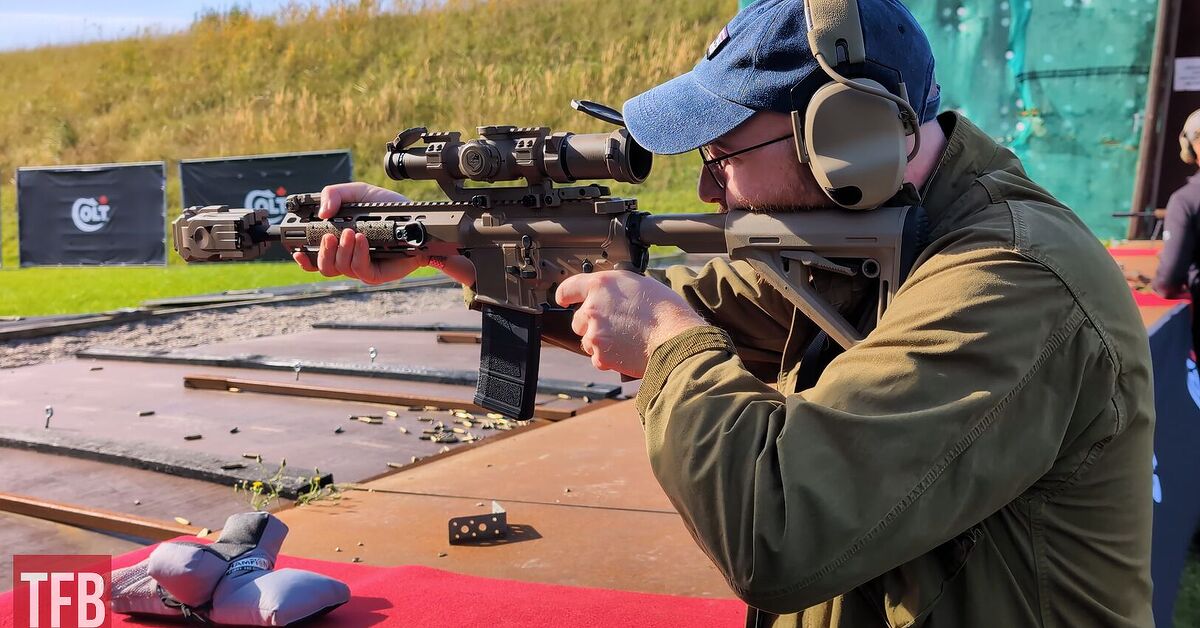
Canada adopted a rifle built around one idea: stop aiming at the armor. The Colt Canada C25 came out of the Canadian Modular Assault Rifle (CMAR) project and entered Canadian Armed Forces service earlier this year. At a range day in Copenhagen this month, Colt Canada put the rifle in front of journalists. Matthew Moss fired about 100 rounds of Sellier & Bellot SS109 through a C25 fitted with a 1-6x low power variable optic. The pitch is simple. Plates rated for rifle threats have made 5.56mm less effective at center mass, so Canadian troops are now taught to aim at the head, neck, lower abdomen, groin, and legs.
Key Details
The C25 is an evolution of the Colt Canada C8A4 Modular Rail Rifle, adapted to Canadian Army requirements. Its key specifications and features:
- Length: 32in (813mm) to 35.2in (895mm), depending on stock position.
- Weight: 7.61 lb (3.45 kg) unloaded, without optics, with the MFMD installed.
- Barrel: 13.7in (348mm), 1:7 twist, cold hammer-forged chrome-moly vanadium steel with revised geometry.
- Trigger: A two-stage unit unique to the C25, with a smooth first stage, a predictable break, and a short reset.
- Ergonomics: 5-slot MLOK forend, monolithic upper receiver, ERGO 2 pistol grip as standard, and fully ambidextrous controls.
- Optics: A new 1-6x LPVO. Colt Optics' CQS-1 red dot also appeared on demo rifles.
- Muzzle device: The Millbrook Strategic Sciences Multi-Function Muzzle Device (MFMD), directly threaded and standard across the entire C25 fleet. Canada reportedly tested 14 suppressors from various makers before picking it.
- Ammunition: Optimized for SS109 (C77 Ball). Colt Canada is testing other 5.56x45mm loadings.
- Effective range: Rated to 300m, according to Tim Moore, Colt Canada's Director of International Business Development.
Canada and Defence Research and Development Canada (DRDC) reviewed alternatives and kept 5.56x45mm for individual weapons. Colt Canada's design uses direct impingement, which the company calls expansion gas bleed-off.
Background
The C25 sits on the Stoner lineage that produced the AR-15. Canada's older C7 rifle and C8 carbine trace back to the FN FNC design, and the C8A4 gave Canada its modular rail platform before CMAR. The US Army took a different route. Its Next Generation Squad Weapons program chose the 6.8x51mm cartridge for close combat units, prioritizing power and penetration against armor. Other militaries have stayed with 5.56 and 7.62x51mm, citing logistics, training costs, and proven performance. Canada falls in the second group. Its answer was not a bigger round. It was a better rifle and a different aiming point. That shift in doctrine is the real change here, and the C25 is the hardware built to support it.
Why It Matters for Gun Owners
No civilian can buy a C25. The rifle is a military contract item, and its MLOK forend, two-stage trigger, LPVO, and ambidextrous controls are not restricted, but the rifle itself is not for sale. The impact lands elsewhere. Expect more manufacturers to pitch monolithic uppers, flow-through muzzle devices, and two-stage triggers as combat accuracy upgrades. Those parts will show up in the civilian AR market. Watch the muzzle device closely. A flow-through design that reduces sound signature can fall under federal suppressor rules, depending on how it is built and marketed. If you copy that design on a civilian rifle, check ATF classification and state law before you thread the barrel. Owners in states with strict suppressor or accessory rules should verify their setup before buying any MFMD clone.
DownRange Analysis
The C25 won't face a Bruen challenge, but the doctrine behind it raises a useful point for civilian owners. Canada is teaching soldiers to shoot at targets the armor leaves exposed. That reflects a plain truth about rifle fights: accuracy under stress beats raw cartridge power. The trigger, optic, and muzzle device all serve that goal. Civilian buyers should read the C25 as a parts roadmap, not a shopping list. Upgrade the trigger and the optic before you chase a bigger caliber. Put rounds on target at 300 meters with your own LPVO, and log your hits under time pressure. If you run a flow-through muzzle device, confirm its legal status before you install it. The C25 shows where the market is heading. Your range time determines whether the hardware matters.