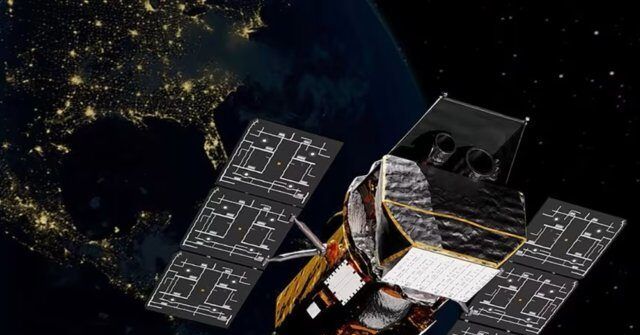
NASA's Swift Observatory Reenters Today, and the US Sits Outside the Debris Zone
NASA's Swift Observatory is coming down. The gamma-ray telescope that hunted cosmic explosions for 21 years is expected to hit the atmosphere Wednesday, November 4, 2026, around mid-morning, according to agency tracking. The spacecraft weighs roughly 3,200 pounds. NASA's reentry map covers Central and South America, Africa, South and Southeast Asia, northern Australia, and sections of the Pacific, Atlantic, and Indian oceans. The continental United States and Europe sit outside that footprint. Anyone in the US who hears about this should know the risk to them is effectively zero.
Key Details
The numbers and dates below come from NASA and the reporting around the reentry.
- Spacecraft: Swift, roughly 3,200 pounds
- Expected reentry: Wednesday, November 4, 2026, mid-morning
- Launch: 2004, with a prime mission of two years
- Actual service life: 21 years
- Likely debris zone: Latin America, Africa, southern Asia, northern Australia, plus parts of three oceans
- Excluded regions: The United States and Europe
- Rescue mission: A spacecraft called Link, launched in early July, cost $30 million
- Rescue failure: Link entered an uncontrollable spin a few weeks after liftoff; controllers slowed the tumble but never regained reliable pointing, and NASA called the rescue off in August
- Science record: More than 2,000 gamma-ray bursts and 1,400 exploding stars observed
- Shutdown: Systems powered down in late October
NASA says re-entry locations for any surviving components vary by hemisphere and depend on the exact time of reentry. NASA Administrator Jared Isaacman said the failed rescue was not the outcome the agency wanted, but that the attempt was still worth making. John Nousek, a Penn State astronomer who worked on the mission, said the end of an object in low Earth orbit is always a fall, and that this one will be catastrophic for the spacecraft.
Background
Swift launched in 2004 with a planned life of two years. It operated for more than twice that. Its job was to scan the sky for gamma-ray bursts, the brief and violent flashes that mark some of the universe's most energetic events. Swift could slew quickly toward a sudden flash and alert larger instruments such as Hubble and Webb, which then studied the target in detail. That first-responder role made it one of the most useful tools in high-energy astronomy.
The problem was altitude. Satellites in low Earth orbit slowly lose height to atmospheric drag. When solar activity rises, the upper atmosphere heats and expands, and drag increases. Swift's orbit decayed faster than planners had expected, which pushed NASA to attempt the Link rescue in mid-2026. That effort failed, and Swift kept collecting data until its orbit dropped too low to hold steady for observations. NASA has deorbited observatories before. The Compton Gamma Ray Observatory came down in 2000 under controlled conditions. Swift is not getting that kind of planned reentry, which is why the debris footprint is so wide.
Why It Matters for Gun Owners
Nothing in this story touches firearms law, ammunition, or the Second Amendment. No court ruling, bill, or ATF action is involved. Still, there is a practical point for anyone who carries or shoots outdoors. Uncontrolled reentries put debris on the ground in unpredictable places, and the rule for any metal fragment you find is the same as for any unknown object: do not handle it, mark the location, and call local authorities. Some fragments may be hot, sharp, or contain hazardous materials. If you travel to Latin America, Africa, southern Asia, or northern Australia in the coming days, keep that in mind during range trips, hunts, or outdoor work. The United States and Europe are outside the predicted zone, so the risk to shooters there is effectively nil. The bigger lesson is that orbital hardware eventually comes down, and the people who live under the flight path usually find out last.
DownRange Analysis
This is not a Bruen story. No firearm regulation is being tested, and no constitutional question is in play. What DownRange can offer is a clear read on the risk. The reentry is a real event with a real debris footprint, but the odds that a fragment injures anyone are low, and the odds for American and European readers are zero. The market has no angle here either. Nobody needs new gear over a satellite falling into the Pacific. What a gun owner should do right now is simple. If you're in the United States or Europe, do nothing differently. If you're in the debris band, stay away from any unexplained metal object you find and report it. Read the original source for NASA's full reentry statement and the mission history, which go well beyond what fits here.