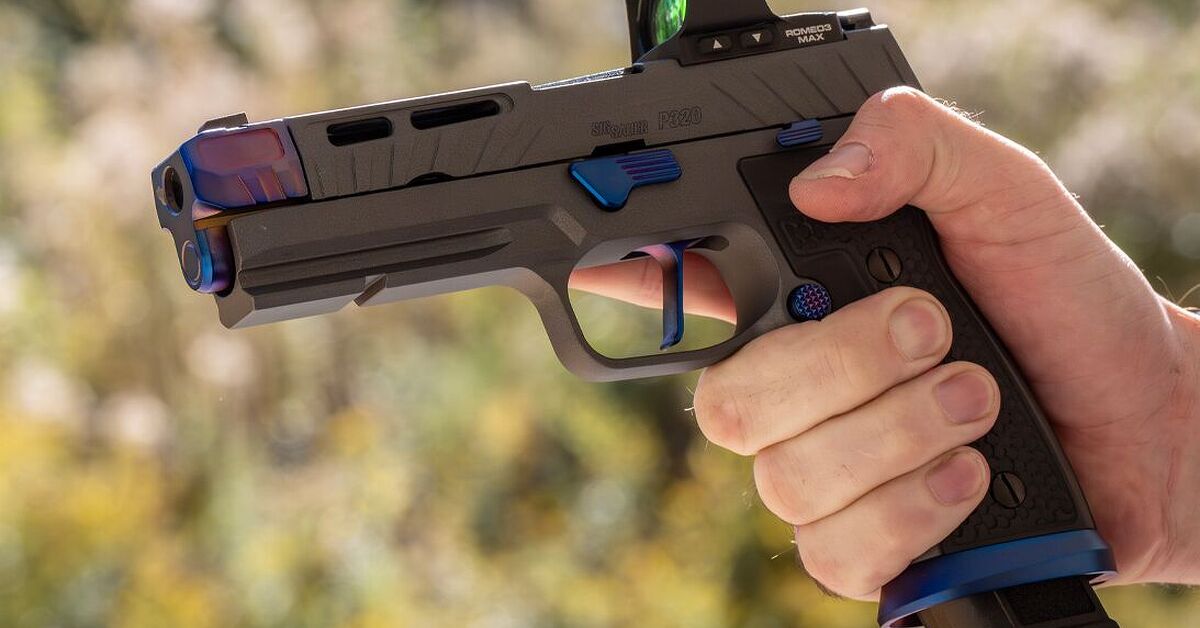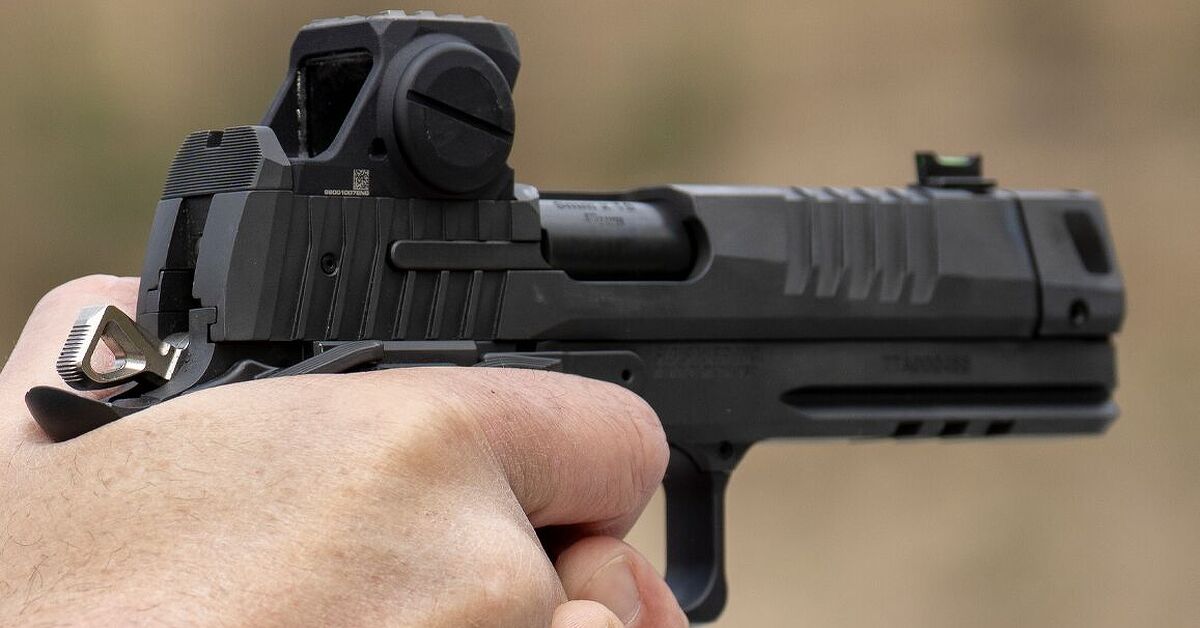
SIG's XRAY5 Ditches Adjustment Screws for a 225-Dot Matrix
SIG Sauer's new XRAY5 pistol red dot has no moving adjustment parts. Its reticle is a fixed 15x15 matrix of 225 individually lit dots, permanently bonded in place. Windage and elevation change by lighting a different dot, so zeroing becomes a software function instead of a screwdriver job. SIG pitches it as the world's first solid-state advanced red dot. The product announcement lists six models across four mounting footprints, but it gives no ship date and no pricing in the text. Expect questions about durability once independent testers get their hands on one.
Key Details
The XRAY5 drops the traditional carrier plate and the screws and springs that move it. Here are the specifics SIG published:
- Matrix: 15x15 grid, 225 dots, each dot measuring 3.5 MOA.
- Adjustment: Windage and elevation are digital. No tools and no counting clicks.
- Optical layout: The collimating lens sits in the roof of the housing, outside the shooter's view. The reticle bounces off that lens and the flat front glass before reaching the eye. SIG calls this its patented Zero Distortion Optical system, or ZDO.
- Battery: SIG claims 10,000+ hours of runtime from the LED emitter. It says holographic designs get roughly 10% of that runtime from the same power source.
- Sealing: Sealed rear window and an argon-purged optical system. Rated fog-proof and waterproof to IPX8.
- Controls: Two buttons on the optic handle power, reticle brightness, windage and elevation, and Lockout Mode. The app is optional.
- App (iOS and Android): Digital zeroing, multiple zero profiles, LightFight, a Round Counter, MOTAC, auto-off, a battery indicator, and a Bluetooth toggle.
- LightFight: Pairs over Bluetooth with the SIG Sauer FOXTROT LF weapon light. When the light turns on, the reticle jumps to a much higher brightness. Two modes are selectable in the app.
- Round Counter: Uses an accelerometer. Firing five rounds during calibration records the host gun's recoil signature. Later rounds get logged. Resettable if the optic moves to another firearm.
SIG advises against loading, unloading, or manipulating the slide or bolt during calibration. Those actions get logged and can throw off the counter's accuracy.
Background
Pistol red dots became mainstream once slide-cut footprints like the Trijicon RMR and Holosun and Aimpoint pistol-mount optics standardized mounting. Almost all of them share one architecture. An LED emitter sits on a carrier plate. Adjustment screws and springs move that plate to set the dot's position. The design has worked for years, and shooters trust it because the failure modes are well known: a loose screw, a worn spring, or a plate that shifts after a hard drop.
Holographic sights, popularized by EOTech, took a different route. They project a 3D reticle onto flat glass and offer a bright, parallax-free aim point. Their trade-offs are power draw and, under some conditions, strobing or streaking when the optic moves fast. Waveguide designs have pushed into the same space. SIG is positioning the XRAY5 against both groups, arguing it keeps LED efficiency while removing the mechanical adjustment system entirely. Whether that trade pays off depends on how the matrix and bonding hold up after years of recoil.
Why It Matters for Gun Owners
Anyone running a pistol red dot should pay attention, especially duty and daily carry users. A mechanical zero is a known quantity. A solid-state zero depends on a bonded matrix and the electronics behind it. If that bond holds through thousands of rounds and repeated drops, the zero retention argument goes to SIG. If it does not, the failure mode looks different from a loose screw, and a field repair may not be an option.
Holster and footprint compatibility matter too. The XRAY5 comes in four footprints. Check your slide cut and holster fit before anyone orders a sight. Shooters who run weapon lights should watch the LightFight feature closely. The pairing with the FOXTROT LF light could help with washed-out dots in bright conditions, but it works only with that light. Anyone expecting it to pair with a different light will be disappointed. Finally, the app dependency adds a phone to the setup for anyone who wants digital zeroing and the Round Counter. Keep Bluetooth off when you don't need it, and make sure the optic works fully without the app.
DownRange Analysis
This is not a Second Amendment story. It is a product story, and the Bruen framework has nothing to say about a red dot's architecture. The question is whether the solid-state claim holds up in the field. A carrier-plate design has years of real-world durability data behind it. The XRAY5 has a press release and a list of quoted durability results. Wait for independent drop, recoil, and submersion testing before treating the bonded matrix as proven.
The Round Counter is a clever addition, but its value depends on accuracy during calibration, and that is a detail users must follow precisely. The 10,000-hour runtime claim sounds strong. The real test is cold-weather performance and battery behavior under duty use. Do not pre-order on specs alone. Keep your current optic zeroed, shoot it at your next range session, and watch for third-party reviews before spending money on a new sight.