Vickers Machine Gun Served Britain 56 Years — Bisley Exhibit Proves It
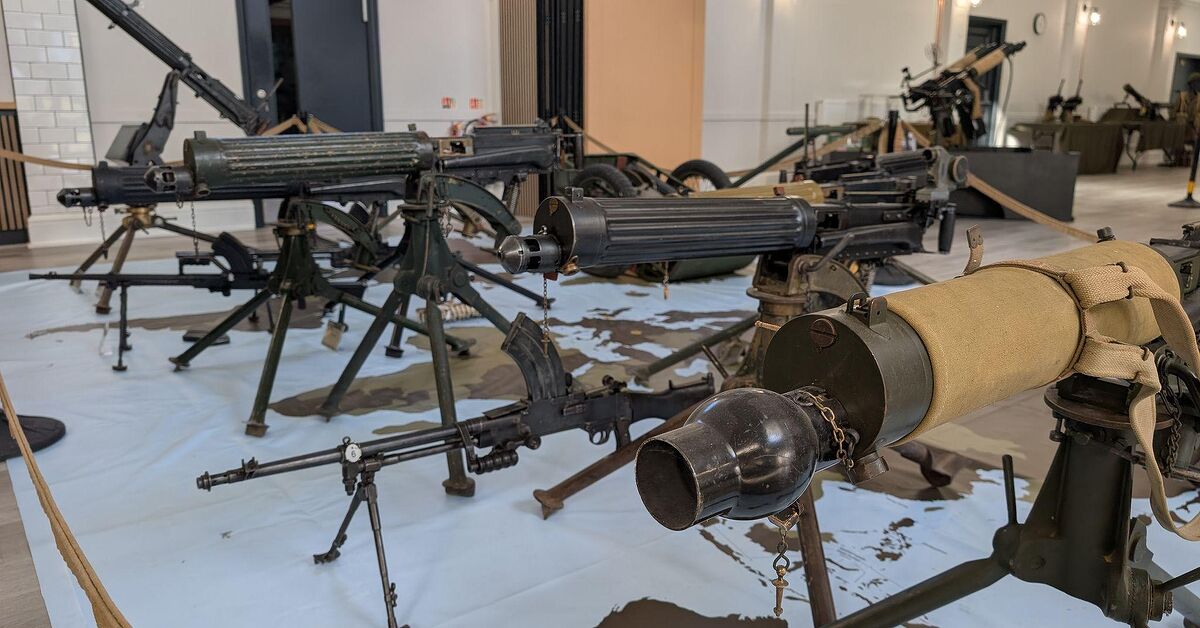
The Vickers machine gun stayed in British Army service for 56 years, and a UK charity just built a show around that fact. The Vickers MG Collection & Research Association staged its first major exhibition at Bisley Camp, the historic home of British shooting, from 2 to 5 October. Fifty-six objects told the gun's story across the First World War, the Second World War and the Korean War. The centerpiece was a world map ringed with more than a dozen belt-fed, water-cooled Vickers guns and Vickers-Berthier light machine guns, showing how far the design traveled.
Key Details
The Association is a UK-registered charity. Its stated mission is public education on the Vickers gun and related weapons. The organization built the show around five decades of service, and the displays covered the kit needed to feed, cool and fight the guns, not just the guns themselves.
- Dates: 2 to 5 October, held at Bisley Camp.
- Objects: 56 items tied to the Vickers gun's five-plus decades in service.
- Wars covered: World War One, World War Two and the Korean War.
- Global users on the map: Portugal, Chile, Egypt, Turkey, Israel, Nepal and the Netherlands.
- Rare American piece: a Colt-manufactured M1915 Colt-Vickers used by the US Army in World War One.
- Other highlights: an Irish Army handcart built to move a Vickers gun and its ammunition, plus Vickers-Berthier light machine guns used by the British-Indian Army.
- Mounts and kit: a twin anti-aircraft mount with the full accessory set that would have ridden on a lorry in the early 1940s.
Matt Yates, Chief Operations Officer for the Vickers MG Collection, said the public and professional visitors responded strongly. The group plans more shows, and it posted video of the exhibition for people who could not attend. Details live at vickersmg.org.uk.
Background
The Vickers gun descends from the Maxim gun, the first practical self-powered machine gun. Vickers, Sons & Maxim refined that design into a sturdy, water-cooled, belt-fed weapon. The British Army adopted it in 1912 as the Vickers .303-inch machine gun, and it became one of the defining weapons of the trench war. Its barrel jacket held water to prevent overheating during sustained fire, which gave the gun its legendary reliability and its distinctive silhouette.
The gun did not stay confined to Britain. Export sales and licensed production spread it across Europe, the Middle East, South America and Asia. The Vickers-Berthier light machine gun came from a licensed combination of the French Berthier design with British manufacture, and it served in India and elsewhere. The US Army bought Colt-built Vickers guns in .30-06 for World War One, which explains the American piece on the Bisley map. British service of the Vickers ended in 1968, closing the 56-year run the exhibition highlights.
Why It Matters for Gun Owners
Most American shooters will never touch a Vickers, but the show is a reminder of how machine guns moved through history. For US owners, the more useful lesson is the paperwork. Any live, fully automatic Vickers on American soil falls under the National Firearms Act, and the 1986 Hughes Amendment froze new civilian transferable machine gun registrations. Only guns registered before that date can change hands, and each transfer requires an approved ATF Form 4 and the $200 transfer tax.
Collectors chasing historic guns should check the NFA status before buying any Vickers, Colt-Vickers or Maxim-derived piece. A deactivated gun is not automatically legal to own in every state. Some states ban machine guns outright, regardless of federal registration. Dealers and sellers often overstate what an "inert" gun is allowed to do, so verify the status in writing and keep the ATF documents.
Britain's rules on these guns are far tighter. Civilian ownership of fully automatic weapons falls under Section 5 of the Firearms Act 1968, and ordinary shooters cannot practically own a Vickers. Watch that gap. Foreign collectors and museums keep the surviving examples alive, and that history depends on access to documented, legally held guns.
DownRange Analysis
This exhibition makes a strong case for preserving military small arms as historical objects. A display built around a single weapon, with serious logistics and global context, shows how a gun becomes a story. American collectors should copy the approach: document provenance, keep manuals and accessories, and record every ATF transaction. The Colt-Vickers M1915 on display carries a US military lineage that American collectors rarely see in person.
The market implication is simple. Pre-1986 registered machine guns hold their value because the federal supply is closed. Anyone buying into that market should treat the NFA paperwork as the product, not an add-on. Before you buy, confirm the registration, the state law, and the dealer's paper trail. Then store everything in one folder, because the transfer record is what carries the value.