OCC Report Finds Big Banks Had Policies That Squeezed Gun Firms
A federal regulator just put paper behind years of gun-industry complaints. The Office of the Comptroller of the Currency released a report finding that all nine of the largest national banks under its supervision maintained policies between 2020 and September 2025 that could steer decisions to deny financial services based on beliefs, affiliations or lawful business activity. Firearm manufacturers and retailers were specifically named in the review. Gun Owners of America flagged the report in its latest Minute Man Moment. The OCC reviewed roughly 100,000 complaints and about 50,000 documents running to 420,000 pages. Several banks restricted financing for gun makers and sellers.
Key Details
The report covers a specific set of institutions and a specific window of time. Here is what it establishes:
- $12.7 trillion in assets held by the nine banks as of September 2025, roughly 76 percent of everything the OCC supervises.
- 100,000 complaints reviewed, along with about 50,000 documents totaling approximately 420,000 pages.
- Policies under review ran from 2020 through September 2025.
- Some banks restricted services to companies selling firearms labeled “assault-style” or “military-style.” Certain firearm accessories also appeared in some bank policies.
- Comptroller Jonathan Gould described a bank that refused to assist a firearm company with an initial public offering. The company’s lawful firearm-sales policies reportedly did not match the bank’s internal standards.
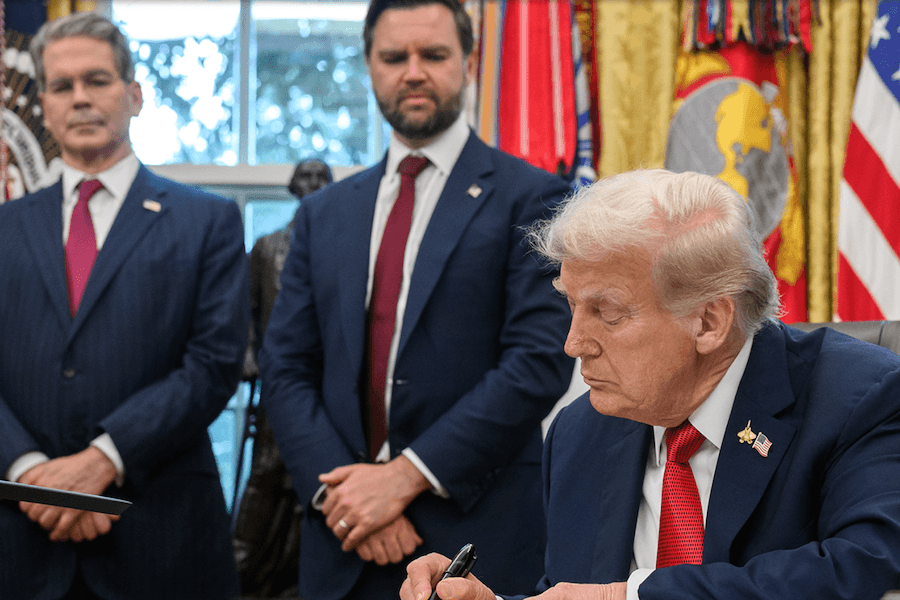
- President Donald Trump signed Executive Order 14331 in August 2025. It directed regulators to examine politically motivated debanking and remove vague “reputation risk” standards.
- The OCC says it has removed reputation risk from its supervisory framework, is improving its complaint process, and will weigh a bank’s debanking record when reviewing major applications, including mergers and branch expansions.
The report defines debanking broadly. It covers account closures, denied loans, refused payment processing, and refusal to work with a business for reasons unrelated to its ability to pay. The report also does not claim all nine banks targeted gun companies. The finding is narrower and still serious: the policies existed, and some banks used them against firearm businesses.
Background
This fight did not start in 2025. Gun retailers and manufacturers have complained about banking access for more than a decade. Between 2013 and 2017, the Justice Department’s Operation Choke Point pressured banks to cut off businesses regulators considered high-risk, and firearms dealers appeared among the targeted categories. Critics argued the program used regulatory pressure to do what the government could not do directly. The initiative ended, but the practices it encouraged did not disappear.
GOA and other Second Amendment groups kept pressing the issue. A 2025 GOA campaign accused major banks of using “values-based” standards to freeze lawful firearm companies out of financial services. The complaints were often anecdotal. Many gun owners and business owners had no hard data to show regulators or lawmakers. The OCC report changes that. It gives the industry a federal document to cite, and it comes from a regulator that examined the institutions directly.
Why It Matters for Gun Owners
Banking access determines whether a gun business survives. A shop that cannot process card payments loses walk-in sales and online orders at the same time. A manufacturer denied a loan cannot finance inventory or hire a second shift. A company refused an IPO cannot raise the capital needed to expand. These are not abstract problems. They determine prices, selection, and how many jobs stay in the firearms supply chain.
The impact falls hardest on independent dealers, small manufacturers, and ammunition and accessory makers. Large national chains have banking relationships and legal teams. A two-person machine shop producing AR parts in a rural county does not. Gun owners in every state feel the effect when a favored maker raises prices or a local shop closes. If you buy from small firearm businesses, you have a direct stake in this report.
Watch for three things. First, whether the OCC follows through on complaint-process changes and publishes results. Second, whether your own bank or payment processor has any written policy on firearm customers. Third, whether state legislatures move to restrict discrimination in financial services based on lawful industry. Several states have already debated such bills, and the OCC findings give lawmakers a federal reference point.
DownRange Analysis
Bruen governs government restrictions on arms. It asks whether modern regulation fits within the nation’s historical tradition of firearm regulation. Private banks are not state actors under that test. The OCC, however, is a federal agency, and federal supervisors pressuring banks to cut off lawful gun businesses raises a real constitutional question. Regulators that use reputation-based pressure to shrink a lawful industry look a lot like the indirect burdens the Second Amendment community has challenged for years.
The market implication is simple. Gun businesses that lost banking access in recent years now have federal findings to cite when they reapply or appeal. Expect more firearm companies to document their banking denials and file complaints with the OCC.
What should a gun owner do right now? Support the small shops and manufacturers that get squeezed first. Check whether your local dealer accepts cards and has stable payment processing. If you serve on a board, a city council, or a state commission that deals with financial services, ask how public funds are placed and whether those institutions follow lawful-industry neutrality. Then read the OCC report yourself. The primary source tells you what regulators found, and that is the document your next conversation with a banker should cite.