Rifles Are Under 4% of Murders as AR-15 Ownership Climbs
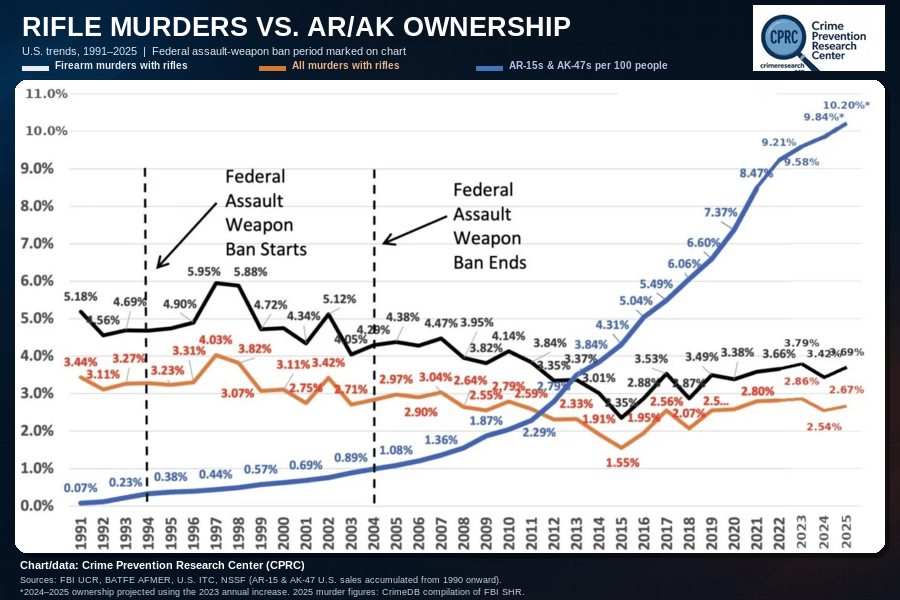
The U.S. Supreme Court hears Viramontes v. Cook County and Grant v. Higgins on December 2, and the central question is whether the Second and Fourteenth Amendments protect AR-15-platform and similar semiautomatic rifles. New data from the Crime Prevention Research Center, built on FBI Uniform Crime Reporting figures, shows rifles of every kind made up a small and shrinking slice of firearm murders. Over the same stretch, CPRC estimates AR-15 and AK-style ownership rose from about one rifle per 100 Americans in 2004 to 10.2 per 100 in 2025. Governments want to ban the most popular rifle in the country, and the murder numbers do not support the argument that they need to.
Key Details
The CPRC analysis compares rifle murder shares across three periods. Each figure reflects all rifles, not just AR-15s, because the FBI does not separate them.
- Before the federal "assault weapons" ban took effect in September 1994, rifles accounted for 4.8% of firearm murders.
- During the 1995 to 2004 ban period, that share was 4.9%.
- After the ban expired, the share fell to 3.6%. For the first 10 years after expiration, the average was 3.86%.
- CPRC estimates AR-15 and AK-style rifles grew from roughly one per 100 Americans in 2004 to 10.2 per 100 in 2025, a tenfold increase.
Put another way, out of 100 firearm murders, fewer than four involve a rifle of any type. CPRC's own author concedes the data does not prove that rising AR-15 ownership caused the drop in rifle murders. The analysis does argue the reverse claim is hard to sustain. If widespread availability drove murder, both lines should have climbed together. They did not. The analysis also notes that statistics alone will not settle the constitutional question.
Background
Congress passed the federal assault weapons ban as part of the 1994 crime bill, and it took effect in September 1994. It sunset in September 2004 and was never renewed. The ban restricted certain semiautomatic rifles by features and banned magazines above ten rounds, so its effect on rifle murder rates has been debated since the day it expired. Researchers across the ideological spectrum have struggled to isolate a measurable effect from the ban in the crime data, and the CPRC numbers add to that record.
The legal framework changed more than the statistics. In District of Columbia v. Heller (2008), the Court recognized an individual right to keep and bear arms and suggested that weapons "in common use" for lawful purposes receive protection. In New York State Rifle & Pistol Association v. Bruen (2022), the Court replaced the older interest-balancing tests with a text, history, and tradition standard. Under Bruen, the government must show that a modern restriction fits within the nation's historical tradition of firearm regulation. The Seventh Circuit upheld the Cook County ban under the earlier framework, which is why the Supreme Court's review now matters so much.
Why It Matters for Gun Owners
The direct exposure falls on owners in states and localities that already restrict or ban AR-platform rifles. New Jersey, New York, Connecticut, California, and Illinois all have heavily regulated or banned categories, and Cook County sits inside that map. If the Court upholds these bans, expect other jurisdictions to copy the language quickly, and expect enforcement to follow the most aggressive local interpretation. If the Court strikes them down, the ruling will not automatically erase every state registration scheme or feature restriction, so owners in those states still need to read the final opinion closely.
Right now, document what you own. Keep purchase records, serial numbers, and any state registration confirmations in a single secure location. Know your state's rules on magazine capacity, featured rifles, and transport. If you live in a restrictive state, do not assume a favorable ruling changes your status overnight. Watch the December 2 arguments and the opinion when it arrives, and track how the justices frame "common use," since that phrase will carry weight in every future challenge.
DownRange Analysis
Under Bruen, murder statistics are the wrong tool. A court applying a text, history, and tradition test will look for historical analogues, not crime curves. That makes the CPRC data useful for public debate but limited in court. Still, the common-use framework from Heller gives the statistics some relevance, because ownership at the scale CPRC estimates is hard to call unusual. Thirty-plus years of rising AR-platform ownership supports the claim that these rifles are in common use, and the government will have to explain why a tool used by millions for lawful purposes falls outside protection.
The market already reflects this fight. Prices on AR-platform rifles and magazines spike around court dates and legislative sessions, and that pattern will repeat around December. Do not buy on panic alone. Buy when you need the gun, and buy from dealers who keep clean paperwork. The smartest move right now is to get involved: support Second Amendment litigation groups, contact your state legislators, and make sure your local representatives know which votes you track.