Court Rejects Hawaii's ‘Vampire Rule’ and Its Black Code Defense
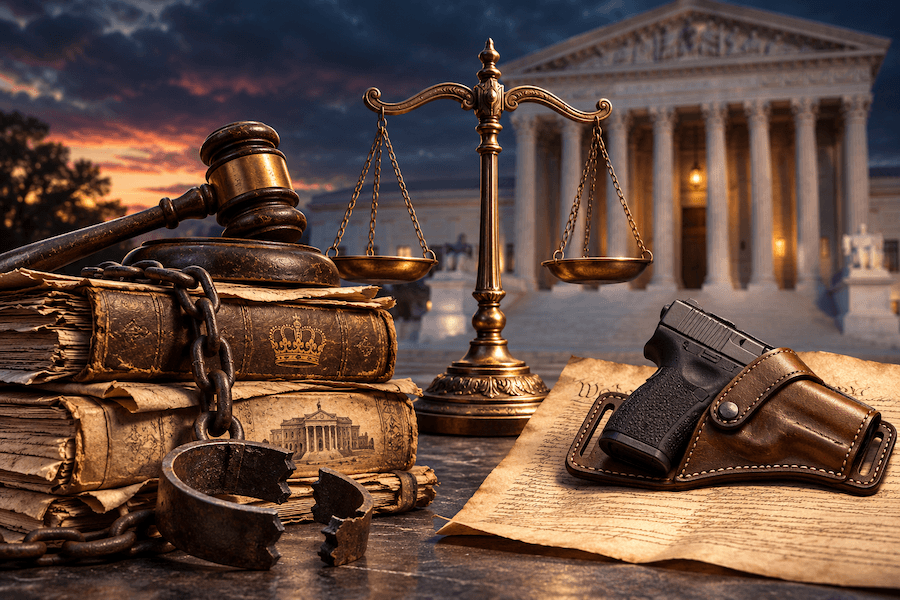
The Supreme Court struck down Hawaii's ‘vampire rule’ in June 2026, ruling 6-3 in Wolford v. Lopez that the state cannot bar licensed carriers from ordinary businesses open to the public unless owners opt in. Hawaii defended the policy with colonial hunting laws, pre-statehood monarchy restrictions, and an 1865 Louisiana Black Code. The justices rejected all three. Now a new essay in the Yale Law Journal Forum, co-written by NRA-ILA Litigation Director Joseph Greenlee and University of Wyoming law professor George Mocsary, uses that case to explain how courts should treat ugly historical laws. Its core claim: oppressive statutes belong in the file of constitutional warnings, not the file of precedents.
Key Details
The facts of the case are straightforward, and they matter for anyone who carries daily.
- Ruling: The Supreme Court decided Wolford v. Lopez in June 2026, 6-3. The majority held that Hawaii's law severely burdened the carry right recognized in Bruen.
- The rule: After Bruen in 2022, Hawaii barred licensed carriers from entering private property open to the public unless the owner gave express permission or posted a sign allowing firearms.
- Who it hit: Gas stations, grocery stores, restaurants, and coffee shops were off-limits by default.
- State's evidence: Colonial anti-poaching laws, restrictions from Hawaii's pre-statehood monarchy, and an 1865 Louisiana Black Code.
- Court's response on hunting laws: Those statutes governed people entering someone else's land to kill game, not licensed citizens buying groceries with handguns for protection.
- Court's response on monarchy rules: The Constitution means the same thing in Hawaii as elsewhere. A state cannot shrink a national right using rules that predate its admission to the Union.
- Court's response on the Black Code: The law belonged to a system built to disarm newly freed Black Americans. The Court said Hawaii's use of it “cannot be taken seriously.”
The essay proposes four questions courts should ask of any historical law: how widespread it was, why lawmakers enacted it, whether Americans accepted it, and whether the constitutional order later rejected it. The authors use a simple example. A historical segregation law proves segregation existed. It does not prove segregation complies with the Fourteenth Amendment. Laws designed to disarm vulnerable groups work the same way.
Background
Bruen changed the framework in 2022. The Court held that the Second Amendment protects carrying arms in public for self-defense. It also replaced interest balancing with a test built on text and history: the government must show that a restriction fits the nation's historical tradition of firearm regulation. Judges now ask whether a modern law has a real historical analogue, and states have been digging through the past to find one.
Hawaii did not simply deny permits. It reversed the default. Property owners have always been free to ban guns on their premises. Hawaii's rule flipped that baseline for the state, turning nearly every public business into a no-carry zone unless the owner acted. Hawaii joined the Union in 1959, and its monarchy ended in 1893, so the monarchy-era rules predated statehood by decades. Black Codes passed across the South in 1865 and 1866 restricted the rights of freedpeople, including their access to firearms. The Fourteenth Amendment, ratified in 1868, was written in direct response to that kind of abuse. Hawaii's lawyers reached back to that era to justify a 21st-century carry restriction, and the Court refused to accept the reasoning.
Why It Matters for Gun Owners
If you carry in Hawaii, this ruling removes the state's ability to make ordinary shopping a legal gray area. Licensed carriers no longer need a sign on the door to enter a grocery store under a default-ban regime. Hawaii's enforcement posture will change in practice, and gun owners should expect confusion for months while agencies and businesses adjust.
The broader impact reaches any state that reversed the private-property default. New York and California enacted similar provisions after Bruen, and both drew lawsuits. A ruling against one state's version does not automatically void another's. Each challenge still requires its own litigation, its own record, and its own judges. Gun owners in those states should track those cases closely rather than assume the law has already changed.
The essay also matters for future fights over sensitive places and other restrictions. Governments will keep hunting through old statutes for something that looks similar. The four-factor test gives litigators a way to argue that a historical law is a bad analogue because it was discriminatory, widely rejected, or built to suppress a group. Keep records of where you carry, read posted signage, and carry your permit and a copy of applicable state law.
DownRange Analysis
This decision is good for the Second Amendment, and the reasoning is tighter than the headline. The Court did not just say Hawaii picked bad history. It said the analogues did not match the modern burden. Hunting laws regulated trespass onto land. Monarchy rules came from a government outside the constitutional order. A Black Code came from a regime designed to strip rights. None of those mirror a licensed carrier buying milk. That is the kind of mismatch Bruen demands courts examine.
The Greenlee and Mocsary framework goes further than most Second Amendment commentary by asking whether a historical law reflects the constitutional tradition or betrays it. That question will matter in courtrooms long after Hawaii's rule is gone. Gun owners should expect states to cite old laws more carefully, and expect courts to demand evidence of how those laws operated.
What should you do right now? If you live in Hawaii, carry lawfully, verify the posted policy at each business, and document any encounter that goes wrong. If you live in a state with a default-ban rule, support the litigation and do not assume the law is dead. Keep your carry habits consistent with current statute until a court tells you otherwise. Courts win cases on record, and so do gun owners.