FBI Data Shows Violent Crime Dropped 9.3% While Americans Bought More Guns
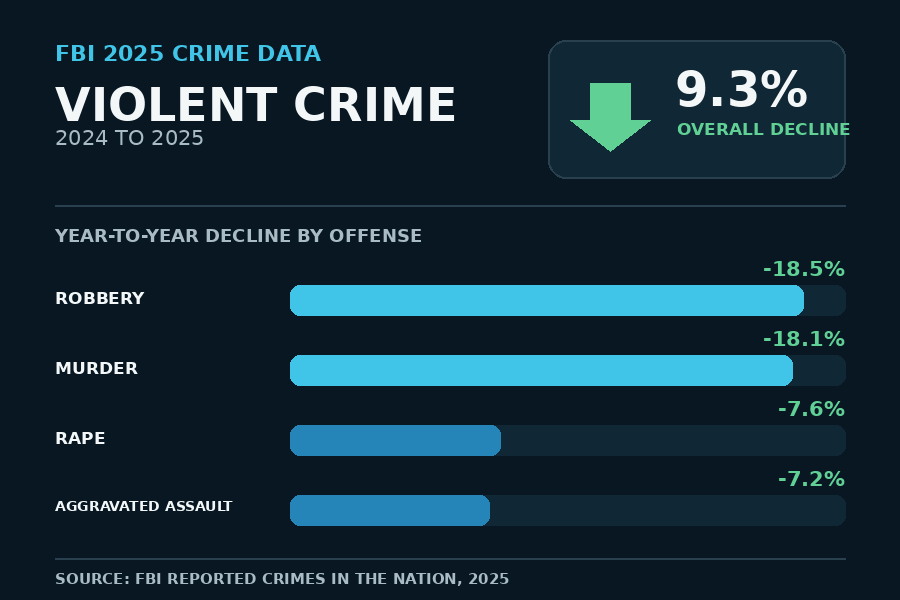
The FBI's 2025 Reported Crimes in the Nation statistics document a 9.3% decline in violent crime between 2024 and 2025. This drop occurred during sustained firearm sales increases across the United States. The numbers directly challenge the anti-gun narrative claiming more guns automatically produce more violence.
Violent crime fell 9.3% year-over-year according to FBI official data. The decline tracks through the FBI's standard Uniform Crime Reporting (UCR) system. Civilian firearm ownership and purchases remained at high levels throughout this period. The correlation anti-gun advocates claim between gun ownership and violent crime simply doesn't exist in the actual data.
Why It Matters for Gun Owners
This data destroys the rhetorical foundation supporting magazine bans, waiting periods, and red-flag laws. When politicians argue that restricting your firearm access reduces crime, they're operating on a hypothesis contradicted by the FBI's own numbers. Gun owners can cite this baseline fact directly when legislators propose further restrictions.
The message to policymakers is clear: violent crime is falling even as gun ownership remains high or increases. That shifts the burden of proof squarely onto anyone proposing new restrictions. They must now explain why additional gun control is necessary when violent crime is already declining while Americans are buying more firearms, not fewer.
Use this data in conversations with legislators, community groups, and undecided voters. The FBI's own statistics prove their causal link between gun ownership and violent crime doesn't hold water. Magazine capacity limits, ammunition taxes, and new licensing schemes all claim public safety justifications. The real-world outcome contradicts those claims. Violent crime is dropping, period.
Gun owners should weaponize this data point in both legislative battles and cultural arguments. When someone argues for stricter gun laws "for safety," you have the FBI's official response: violent crime is already falling. More guns didn't cause more violence. The evidence simply isn't there.
Background
The anti-gun movement has built its entire policy platform on a single assumption: more guns equal more crime. They've used this claim to justify restrictions on magazine capacity, ammunition availability, and firearm access. They've proposed mandatory waiting periods, universal background checks with registration, and extreme risk protection orders—all supposedly necessary to reduce violence.
For years, gun owners have pointed to international data, defensive gun use statistics, and state-level comparisons showing this correlation doesn't exist. Now the FBI's own crime reporting confirms it. Violent crime isn't increasing alongside gun ownership. It's dropping.
This matters because it shifts where the argument happens. Gun owners no longer need to defend against abstract predictions about future violence. We can point to actual violence statistics and ask anti-gun advocates: why do you want more restrictions when crime is already falling?
DownRange Bottom Line
The FBI's 9.3% violent crime decline during a period of high firearm sales completely undermines the foundational argument for gun control. Violent crime is falling while Americans buy more firearms. That single fact invalidates decade after decade of anti-gun policy justifications. Carry this data with you. Reference it in town halls, legislative hearings, and online arguments. The FBI proved what gun owners have always known: more guns don't equal more crime. The actual data shows the opposite.