FBI data reveals 2% of counties generated 54% of U.S. murders
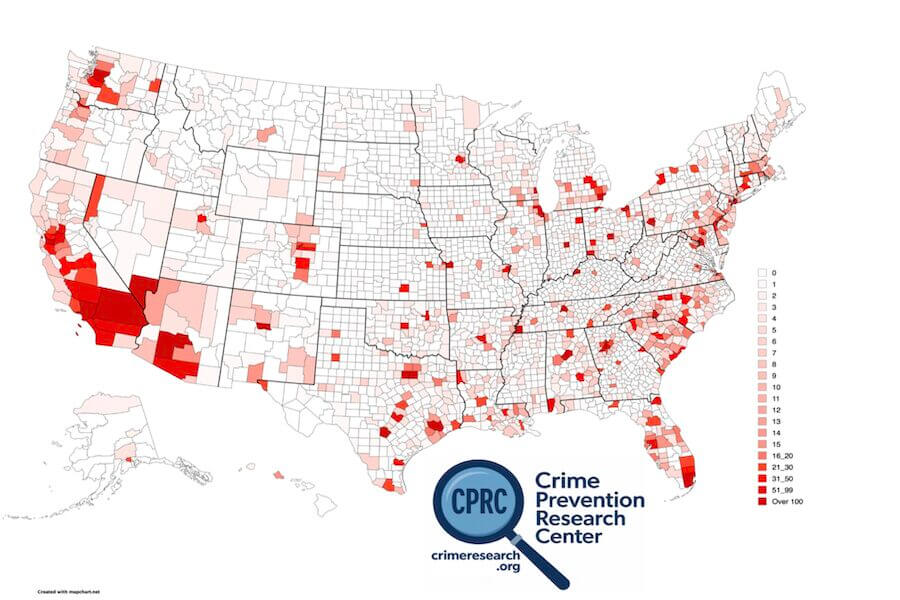
A Crime Prevention Research Center analysis of FBI homicide data exposes a brutal geographic truth: America's murder problem concentrates in a tiny fraction of counties. Just 51 counties out of 3,142 accounted for 54% of all murders between 2020 and 2022. This concentration shatters the narrative that gun violence spreads evenly across the nation.
The top 1% of counties—roughly 31 jurisdictions—generated 42% of all homicides during this period. Cook County, Illinois alone contributed 4,127 murders. New York County posted 1,679. Los Angeles County recorded 2,266. Baltimore, St. Louis, and New Orleans each rank among the deadliest per-capita cities in the developed world.
These aren't rural counties or gun-heavy red states. They're urban cores controlled by prosecutors who reduced charges, declined prosecutions, and released violent offenders. They're jurisdictions where political ideology shaped criminal justice responses more than public safety.
Why It Matters for Gun Owners
This data destroys the anti-gun lobby's favorite argument. Millions of gun owners live in safe counties where homicide rates rival Europe's safest nations. Yet national statistics trap law-abiding shooters under policy restrictions designed for failed urban centers.
The implication cuts deep: Gun owners in functioning counties fund federal policy responses to problems created by anti-prosecution philosophies in failing urban jurisdictions. Magazine capacity limits and red flag laws don't touch the root causes documented here—criminal justice collapse and prosecutor discretion run amok.
Daily carriers understand the gap between statistical averages and lived reality. A gun owner in a 50,000-person rural county faces homicide odds comparable to Tokyo. A resident of inner Chicago faces odds comparable to Bogotá. One-size-fits-all federal restrictions ignore this reality entirely.
This concentration also validates armed self-defense. When 46% of murders occur outside the top 51 counties, police response times and prosecution certainty become unpredictable. Citizens in jurisdictions with weak prosecution have stronger legal and practical arguments for personal security tools.
Background
The Crime Prevention Research Center compiled FBI Uniform Crime Reporting data across multiple years. Their analysis tracked geographic distribution of homicides, revealing extreme concentration in specific urban centers.
Prior studies noted this pattern, but the 2020-2022 timeframe captures the post-George Floyd criminal justice collapse. Across major cities, progressive prosecutors implemented policies reducing charges, declining to prosecute repeat violent offenders, and recommending minimal sentences. Simultaneously, police departments shrunk through retirements and budget cuts.
The result: predictable. Cities with weakest prosecution saw sharpest homicide spikes. Cities with strong prosecution maintained historical averages.
Murder concentration follows prosecution concentration. Check the data on any map. High-homicide counties share one common factor: prosecutors elected on soft-crime platforms who executed those platforms consistently.
DownRange Bottom Line
Gun owners shouldn't accept national policy based on localized criminal justice failure. Fifty-one counties created their violence through prosecutorial choices. Those same counties push restrictions harming millions of responsible gun owners in safe areas.
This data proves gun ownership isn't the violence driver—prosecution weakness is. Armed citizens in failing jurisdictions have stronger legal ground than ever to argue for self-reliance. Armed citizens in functioning counties have unassailable statistical proof that their communities don't need additional restrictions.
Share this number with legislators. Two percent of counties. Fifty-four percent of murders. Every time national gun control advocates cite murder statistics, respond with geography. The problem isn't guns. It's prosecutorial ideology in specific failing cities.