
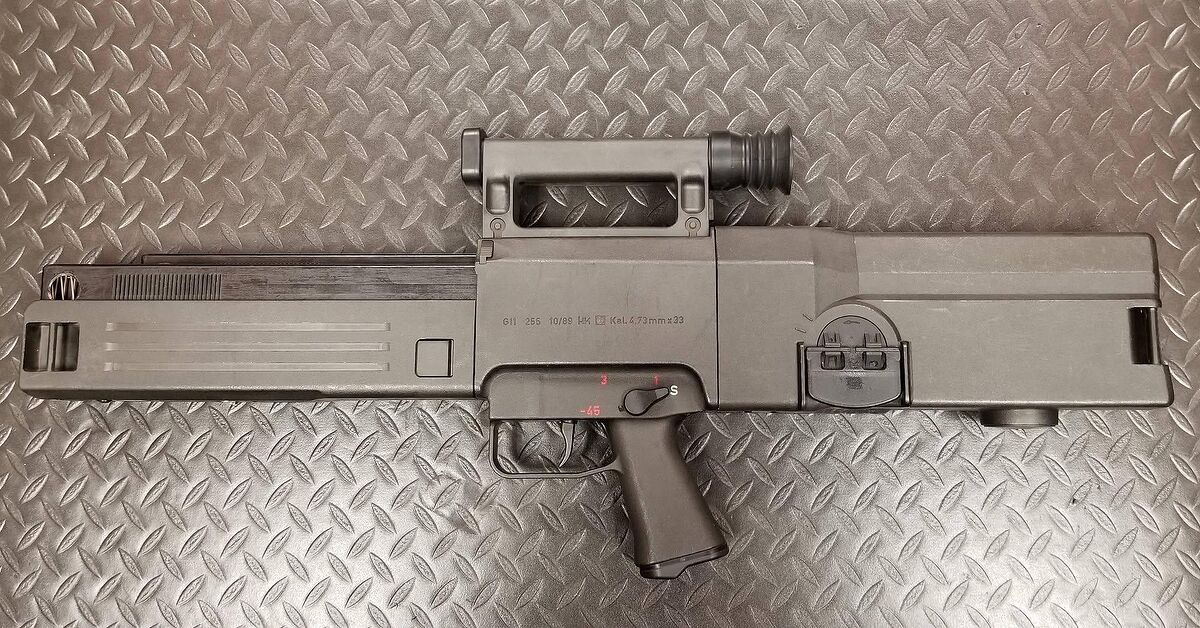
H&K's G11 Caseless Rifle: Twenty Years Too Early, One Decade Too Late
Heckler & Koch's G11 caseless-ammunition rifle reached operational readiness in 1990 — precisely when West Germany lost both the budget and the geopolitical reason to adopt it. Developed across two decades by a West German industrial consortium, the G11 was engineered to become NATO's next-generation infantry standard. Instead, German reunification and the Soviet collapse eliminated the threat that justified the program's cost, and the rifle disappeared from public view into what firearms historians call H&K's classified archives.
Key Details
Development Timeline: The G11 program ran for approximately 20 years before completion in 1990. The rifle fired proprietary caseless ammunition — rounds without brass cartridge cases — a design that promised weight savings, faster fire rates, and simplified logistics compared to conventional 5.56 NATO rounds.
The Fatal Timing: The rifle's completion coincided exactly with the end of the Cold War. With the Berlin Wall down and the Soviet threat evaporating, the West German government could not justify the massive expense required to tool up production facilities, retrain logistics chains, and outfit the Bundeswehr with an entirely new ammunition system. The program was shelved.
Technical Achievement: The G11 represented genuine innovation in rifle design — caseless ammunition reduced weight and bulk, while the weapon's engineering was sound. But superior design cannot overcome political and economic reality.
Why It Matters for Gun Owners
The G11 case study matters to anyone following firearms development because it illustrates how military procurement responds to threat perception, not innovation alone. A rifle that was technically superior and met military requirements still never reached production because the strategic environment changed overnight.
For shooters and collectors, the G11 represents a lost historical path — caseless ammunition never became mainstream, leaving the 5.56 NATO and 7.62 NATO as the default rifle standards worldwide. H&K's decision to abandon the program rather than attempt civilian production shows how thoroughly the rifle was locked into Cold War military thinking. Today, no civilian market exists for G11-pattern firearms or caseless ammunition, and none likely ever will.
This also demonstrates why military-industrial timelines matter: a weapon system that requires two decades of development must emerge into a favorable climate. The G11 did not.
DownRange Analysis
The G11 is a cautionary tale, not a tragedy. H&K made the correct business decision by shelving the program. Retooling NATO logistics around caseless ammunition in 1991 — as the alliance was shrinking and the Soviet Union was dissolving — would have been wasteful and strategically incoherent. The rifle's technical superiority could not overcome the fact that the problem it was designed to solve no longer existed.
What matters now is that caseless ammunition never achieved a foothold in civilian shooting culture. Brass cartridges remain the standard because they work reliably, cost less to produce, and integrate with existing reloading infrastructure. The G11 remains a footnote in Cold War history — a reminder that good engineering without demand equals obsolescence.