SAF Tracks 85 Gun-Control Predictions Against a Falling Murder Rate
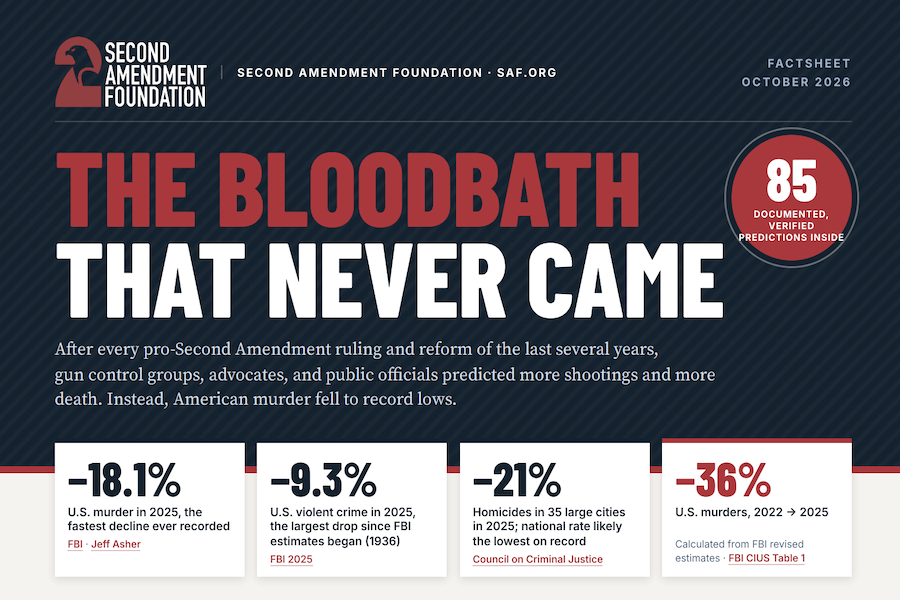
The Second Amendment Foundation just gave gun owners a 10-page answer to the next prediction of blood in the streets. SAF's new fact sheet, titled The Bloodbath That Never Came, collects 85 warnings from gun-control groups, activists and public officials who said expanded gun rights would bring more shootings, deaths and violence. SAF places those quotes beside federal and local crime data from the years that followed. SAF Director of Legal Research and Education Kostas Moros prepared the report, which was published October 14, 2026.
Key Details
The fact sheet does more than stack quotes. Each prediction links to its original source, so a reader can see who said it, when they said it and what they claimed would happen. The sources include Brady, Everytown, Giffords and March For Our Lives. SAF also pulled statements from elected officials, candidates and other public figures.
- Document length: 10 pages, 85 predictions.
- Moros on the record: "They were not even close."
- FBI revised estimates show three consecutive annual declines in murder.
- Violent crime fell 9.3% in 2025, the largest annual drop since the FBI began national estimates in 1936.
- National murder rate: 6.6 per 100,000 people in 2022, 4.1 in 2025. SAF calculates total murders fell roughly 36% over that span.
- Homicides across 35 large cities fell 21% in 2025, or 922 fewer, according to the Council on Criminal Justice.
- New York City recorded 688 shooting incidents in 2025, the lowest in its recorded history. Murders dropped 20.2%, from 382 to 305.
- Preliminary FBI data through July 2026 show the murder rate among reporting agencies running 20.8% below the same period in 2025.
- SAF projects a national rate near 3.2 per 100,000 if the trend holds. That figure is SAF's projection, not an FBI annual estimate. Final 2026 numbers do not exist yet.
SAF Executive Director Adam Kraut framed the goal plainly: give people researched numbers instead of recycled rhetoric.
Background
The predictions SAF tracks trace back to a string of Second Amendment decisions and reforms. In June 2022, the Supreme Court decided New York State Rifle & Pistol Association v. Bruen, striking down New York's discretionary "may-issue" carry licensing. The Court set a new test: regulations must fit within the nation's historical tradition of firearm regulation. Opponents warned that the ruling would flood the streets with guns. In June 2024, the Court decided Garland v. Cargill, rejecting the ATF's attempt to classify bump stocks as machine guns. Since then, a growing number of states have adopted permitless carry, and federal lawmakers in 2025 eliminated the $200 NFA tax on suppressors and short-barreled rifles, effective January 1, 2026. Each step drew public-safety forecasts from gun-control advocates. SAF's fact sheet measures those forecasts against what the crime data actually showed.
Why It Matters for Gun Owners
Every gun owner who carries, hunts or buys a suppressor now lives in a country where these laws are on the books. Concealed carry holders in Bruen-era states face the same argument every time a news story links a shooting to a new carry law. The fact sheet gives you a sourced rebuttal in place of a gut reaction. Permitless carry supporters in states like Arizona and Texas can point to the same national murder trend that SAF documents. Suppressor buyers who stayed out of the NFA market because of the tax should note that the federal tax change took effect in 2026, which means the policy debate has moved from "should this happen" to "what happens now." Watch for the final FBI 2026 numbers. If the trend holds, expect gun-control groups to change the subject rather than admit the predictions missed. Keep the fact sheet handy, and read the qualifier before you post it.
DownRange Analysis
Here is the legal reality. Under Bruen, courts do not weigh crime statistics to decide whether a gun law is constitutional. The test asks whether the government can show a historical analogue for the regulation. That means SAF's best use of this document is political, not judicial. It shuts down the claim that expanded rights caused a crime wave, which matters in legislatures and op-ed pages. It does not win a case. SAF deserves credit for its discipline. It explicitly refuses to claim that Bruen or permitless carry caused crime to fall. That restraint makes the document harder to dismiss. Do not overreach in your own writing. The 3.2 figure is a projection, and the 2026 numbers are preliminary. Cite the Council on Criminal Justice and FBI data by name. Link the original SAF sheet. Your job is to hold opponents to their own predictions, not to claim you have proven the reverse.