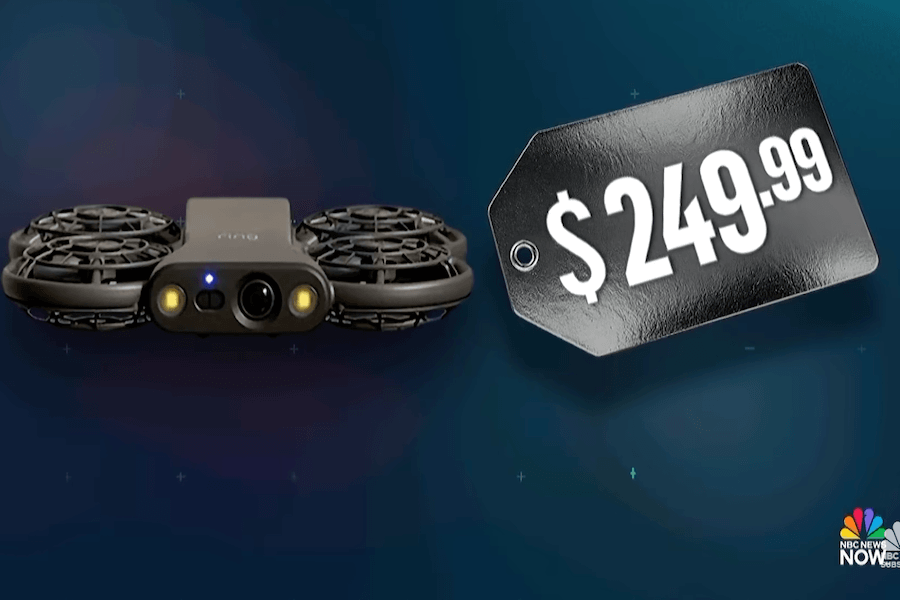
Amazon's $249.99 Ring Drone Can't Stop an Intruder, Yet
Ring, the Amazon-owned camera and doorbell company, has launched a new line called Ring Robotics. It starts with a $249.99 indoor flying camera for homes and a $999.99 wheeled rover aimed mainly at businesses. Neither machine can physically stop a person. The Drone Cam launches from a charging dock and flies preset routes through a house. Ring expects US shipments to begin January 27, 2027, but the drone still awaited FCC authorization when Ring made the announcement.
Key Details
The two products share a theme: they watch and report. They do not respond with force.
- Ring Drone Cam ($249.99): Weighs 165 grams and flies up to eight minutes before returning to its dock.
- Recording: Captures 2K video, uses LED spotlights in dark rooms, and records only while flying. The camera is physically covered while docked.
- Navigation: Avoids obstacles through Ring's cloud-based AI Pilot system. Wi-Fi and cloud processing are required. If the connection drops, the drone lands and stops its patrol.
- Charging math: According to a hands-on review from The Verge, the drone needs about eight minutes on the charger for every minute in the air. A five-minute patrol means roughly 40 minutes docked.
- Triggers: Launches on its own when another Ring device detects motion, an open door, a water leak, or an alarm. Owners can also dispatch it manually from the app.
- Missing hardware: No microphone, speaker, or siren. It cannot give a verbal warning or sound an alarm.
- Subscription: Scheduled patrols and several advanced features require a compatible Ring subscription.
- Rover Cam ($999.99): Patrols single-floor indoor spaces such as warehouses and offices, maps the building, and records up to 4K. It includes two-way audio, infrared night vision, a siren, and a red LED warning tower, all controlled through the app.
- Rover limits: Ring warns it is unsuitable around children under three or small pets.
Background
Home-security drones are not new. Sunflower Labs introduced an autonomous home-security drone system in 2016. It paired outdoor sensors and smart lights with a drone that investigated activity around a property. Ring itself announced the Always Home Cam in 2020, promising many of the same functions the Drone Cam now offers. That product never reached a broad commercial launch. Amazon's contribution is price and distribution. A $250 device that plugs into an existing base of doorbells, motion sensors, and alarms reaches far more buyers than a bespoke system costing thousands. The legal backdrop has also shifted. Since New York State Rifle & Pistol Association v. Bruen in 2022, courts evaluate firearm regulations against the nation's historical tradition of arms regulation. The FAA, which regulates drone operation under federal rules, warns that flying a drone with a dangerous weapon can violate federal law. It cites civil penalties of up to $25,000 per incident without specific authorization.
Why It Matters for Gun Owners
Gun owners should read the Drone Cam as an early warning sensor, not a defensive tool. If you live alone or keep a firearm in the home, a drone can confirm whether an alarm is real before you move. That matters most at night. Confirmation shortens the gap between a sensor trigger and a decision. Still, the drone cannot shout, cannot block a doorway, and cannot protect anyone in the room. Its eight-minute flight window also means it covers only part of a home at a time. Check your network before you count on it. Wi-Fi and cloud dependence create failure points, and a dropped connection ends a patrol. Factor the subscription into the total cost. The Rover Cam matters for small businesses that want audible deterrence without a guard. Its siren and warning lights are the first real alarm features in this category, and they are the features most likely to expand.
DownRange Analysis
Under Bruen, the regulatory question is not about this camera. It is about the next step. A drone that sounds a siren or flashes lights raises little constitutional concern. A drone that sprays, shocks, or delivers any less-lethal payload enters weapons territory. That brings federal drone rules, state weapons statutes, and serious tort exposure into play. Ring has no reason to rush that path. A drone that misidentifies a teenager, a firefighter, or a confused relative creates a liability nightmare that no insurer wants. Our read is simple. Treat these devices as cameras with a subscription. Do not treat them as a replacement for a firearm, a secure door, or a trained response plan. If you want one, buy it for information and speed of notification. Keep your home-defense decisions with humans, and keep your carry and storage practices exactly where they are. The $250 price point will pressure competitors, and that is good for buyers. Shop on features and network reliability, not on the marketing photo.