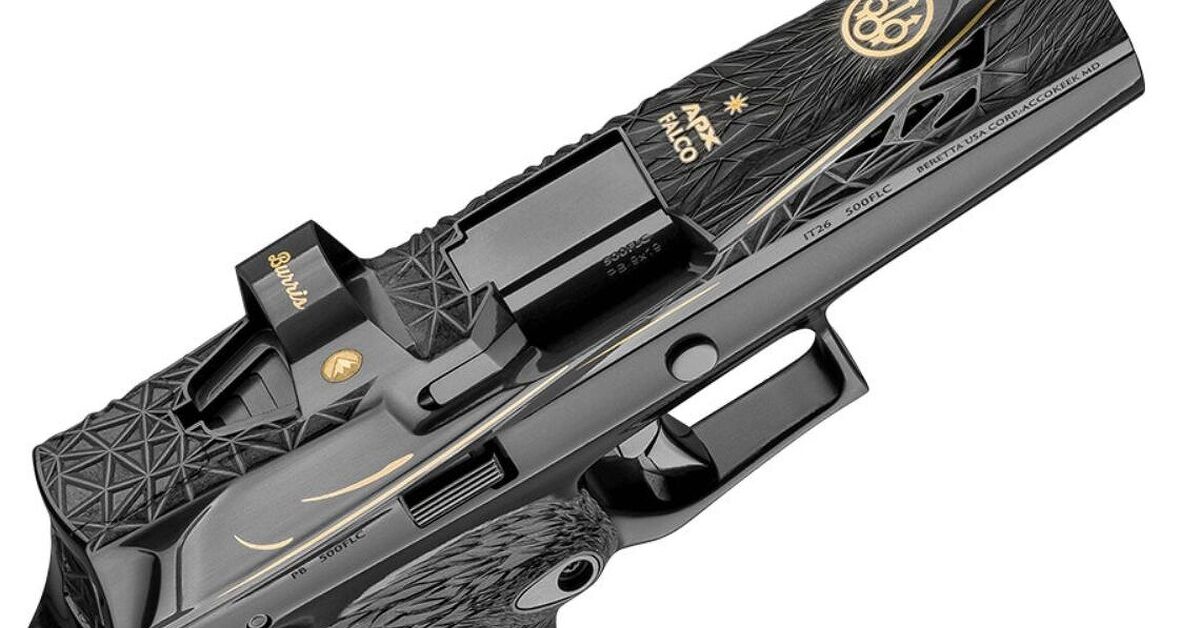
Beretta's APX Falco Machines the Red Dot Into the Slide
Beretta cut the red dot housing and the slide from a single block of steel on its APX Falco, a one-off built for the company's 500th anniversary year. Beretta partnered with Burris, the American optics maker that sits inside the Beretta Group, to make it happen. Beretta calls the result the first monolithic integration of a red dot and a slide, says the design is patented, and claims only Beretta and Burris can build it. The pistol carries gold inlay and hand engraving, but the real story sits under the optic.
Key Details
The Falco is a special-edition APX with no published production run, and Beretta has not announced pricing in the material available. The core facts:
- Optic integration: The red dot is part of the slide, not a plate-mounted accessory. Burris handled miniaturization, insulation, and battery optimization to fit the electronics into a reciprocating slide.
- Claimed benefits: Beretta cites minimal dot height, long-term stability, perfect alignment, and lasting zero retention.
- Frame: A skeletonized steel frame replaces the APX's polymer frame, finished in Diamond-Like Carbon. Beretta says the switch forced a full rethink of weight distribution and balance.
- Slide and barrel: The slide is lightweight and ported, with an integrated compensator. The barrel is shorter and pre-tensioned to reduce vibration.
- Magazine well: Machined into the frame for faster reloads.
- Design theme: The name means falcon in Italian. The magazine release doubles as the falcon's eye, and hand-engraved gold details trace what Beretta calls the path of the eternal spark.
- Case: Machined from a single aluminum block with a black Alcantara interior, French-fitted by the Pietro Beretta Atelier in Gardone Val Trompia.
- Leadership quote: Beretta CEO and GM Carlo Ferlito positions the Falco as a statement piece that separates Beretta from mainstream tactical handgun design.
Background
The APX started as Beretta's polymer-framed striker pistol entered in the US Army's Modular Handgun System trials. The MHS competition aimed to replace the service sidearm, and the APX line went on to become a commercial pistol family. The Falco keeps the APX name and general layout but discards the polymer frame entirely. Beretta treats it as a showcase, not a catalog addition.
Optics on pistols have followed a predictable path. Owners mount red dots to the slide with a plate or adapter, then fit the optic to a footprint such as an MRDS or RMR pattern. Each interface adds a potential failure point: plates, screws, and footprints that are close but not exact. Gun owners have spent years fighting that stack-up of tolerances.
Rifles have offered integrated optics for decades. The Steyr AUG carries an optic built into its carry handle, and the FN P90 places its sight on a fixed receiver top. Both designs keep the sight on parts that barely move relative to the bore. A reciprocating pistol slide is a much harder place to put electronics, which is why Beretta's claim of a first is notable.
Why It Matters for Gun Owners
Few owners will buy a Falco. The price and the limited run keep it on the shelf for collectors. The engineering still matters to anyone who carries a pistol with an optic every day. If Beretta moves this design into the production APX line, it changes the optic conversation for owners who run plate-mounted red dots.
The first thing to watch is serviceability. A slide-integrated optic cannot be swapped, upgraded, or shipped to a repair center on its own. Owners who depend on a specific emitter, brightness profile, or reticle lose that choice. If the emitter fails, the whole slide may need to go back to Beretta.
Battery access is the second question. Beretta has not said how owners would replace a battery or whether the user can do it without a bench. For a carry gun, a battery swap in the field needs to be quick and simple, or the design fails the daily-use test.
Owners of existing Burris optics should also note the corporate tie. Burris optics on other platforms keep their current support structure, and nothing in this announcement changes those products.
DownRange Analysis
Bruen does not touch this. The case tests whether government regulation of arms fits the historical tradition of firearm regulation. A slide with a built-in optic is a product design, and no statute or ruling changes because of it. Nobody needs a historical analogue to sell a pistol with a machined-in dot.
The market question is harder. Integration solves the mounting problem that causes most pistol-optic failures. Beretta says it delivers stability and zero retention, and that claim sounds right on paper. The unanswered issues are repair, battery replacement, and what happens when the emitter dies. Those answers decide whether a production version gets adopted or ends up as a conversation piece.
Right now, do not change your carry setup because of a special edition. Keep your current plate-mounted optic if it runs reliably and you have a repair path. If you are shopping for a new pistol with an optic, check the warranty terms on the optic and confirm who services it before you buy. Wait for Beretta to publish production specs, battery access, and service policy before you treat slide-integrated optics as the new standard.