Wren Metal Works Builds Suppressors Into Henry Lever Rifles
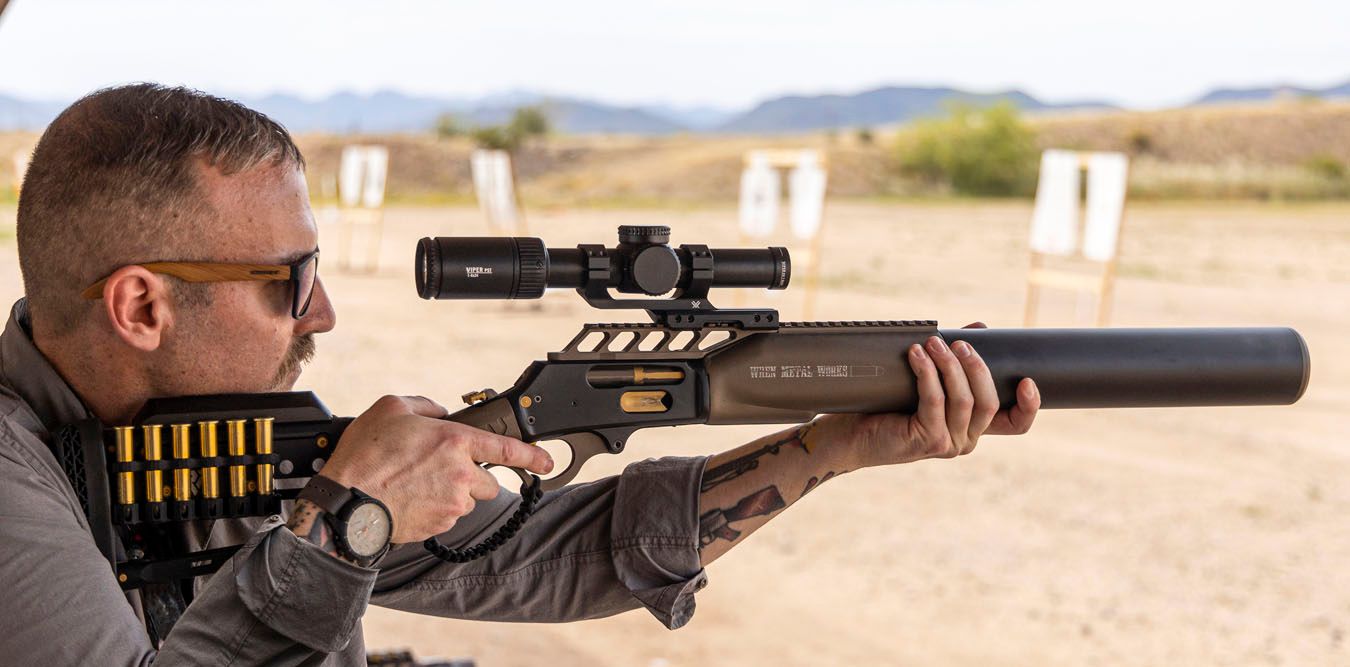
Wren Metal Works converts Henry, Marlin, and Smith & Wesson rifles into integral suppressed guns, with the baffle stack permanently fixed to a shortened barrel. Recoil Magazine contributor Dave Merrill published a hands-on review on November 3, 2026, shooting a .44 Magnum, a magazine-fed .300 Blackout, and a 550-grain load at roughly 1,000 fps. The shop calls these rifles bespoke. You cannot buy one off a shelf. You order one, and the NFA paperwork comes with it. That paperwork matters more to most readers than the sound signature.
Key Details
The reviewed rifles share a few hard numbers worth knowing before you read the full piece:
- 550-grain projectile at 1,000 fps, producing about 1,200 foot-pounds of energy, according to the review.
- .44 Magnum firing 400-grain bullets, described as quiet for the power level.
- .300 Blackout in a mag-fed Henry Lever Action Supreme Rifle (LASR), launched by Henry in January 2025.
- Conversion scope: Henry, Marlin, and Smith & Wesson rifles, either customer-owned or sourced by the shop.
- Build work: shortened barrel, permanently attached baffle stack, removable outer sleeve, smoothed action, Torx screws, tuned carrier arms, lapped bolt face, Picatinny rail, and custom Cerakote.
- Sighting: factory iron sights replaced with a Picatinny rail, with a Lead & Steel Promethean dot optic mounted on the test rifle.
- Shop history: Wren Metal Works was founded about a decade before the review, aimed at quiet, handcrafted, high-performance rifles.
- Bestseller: a Smith & Wesson .357 short-barreled rifle built to pair with the SilencerCo Osprey. It is not an integral design.
Background
Lever actions date to the mid-19th century. The Henry 1860 was the first commercially successful design. It fired .44 rimfire from a 16-round tube magazine, and Union forces used it in limited numbers during the Civil War. Its tube magazine capped its usefulness. Modern makers have tried to fix that. Henry's LASR does it with an AR-style bolt stripped of gas rings, an AR barrel extension, and a linkage and slider-crank mechanism that feeds rounds from a box magazine. That design lets a lever gun use AR-pattern magazines. Suppressors and short-barreled rifles fall under the National Firearms Act of 1934. Until recently, the $200 transfer tax and ATF approval applied to both. Under the 2025 budget reconciliation law, the tax on suppressors and short-barreled rifles dropped to zero starting January 1, 2026. The ATF approval process still applies. Each integral gun still needs federal approval before it changes hands or crosses state lines.
Why It Matters for Gun Owners
An integral suppressed lever gun is a single NFA item. That changes the paperwork picture. A separate can and a separate short barrel means two approvals to track. A factory-built integral rolls both into one assembly, one serial number, and one approved file. Owners should keep the ATF approval paperwork with the rifle at all times, especially when traveling.
State law controls more than federal law here. Several states restrict suppressor ownership or hunting with suppressors, and some ban short-barreled rifles outright or add their own registration. A gun that is legal in Texas may be a felony in New Jersey or California. Check your state and any state you will drive through before you order a conversion.
Watch the shop's process too. Custom work means the rifle you receive is the one ATF approved only if the modifications match the application. Do not remove the outer sleeve, swap barrels, or add parts that change overall length without filing for approval. Buyers who pay for a custom build should get the shop's approved paperwork in writing before they pay the balance.
DownRange Analysis
Bruen changed how courts test gun laws. It did not touch the NFA. Courts have so far upheld suppressor and short-barreled rifle registration against challenges, and the NFA regime remains in force. A build like this still carries federal approval requirements, and no court has ruled that a suppressed lever gun is protected from that process. Expect the challenges to keep coming. Do not bet your build on a favorable ruling.
The market value sits in the custom work. A shop that handles the conversion, suppressor, and sighting in one package charges a premium over buying parts separately. That premium buys convenience and a clean integral design. It does not buy a legal shortcut.
Right now, do three things. Confirm your state allows suppressors and short-barreled rifles. Approve the build with ATF before you fire it. Keep every form, receipt, and approval letter in a file that travels with the rifle. A quiet lever gun is a strong choice. A quiet lever gun without approval is a federal felony waiting to happen.