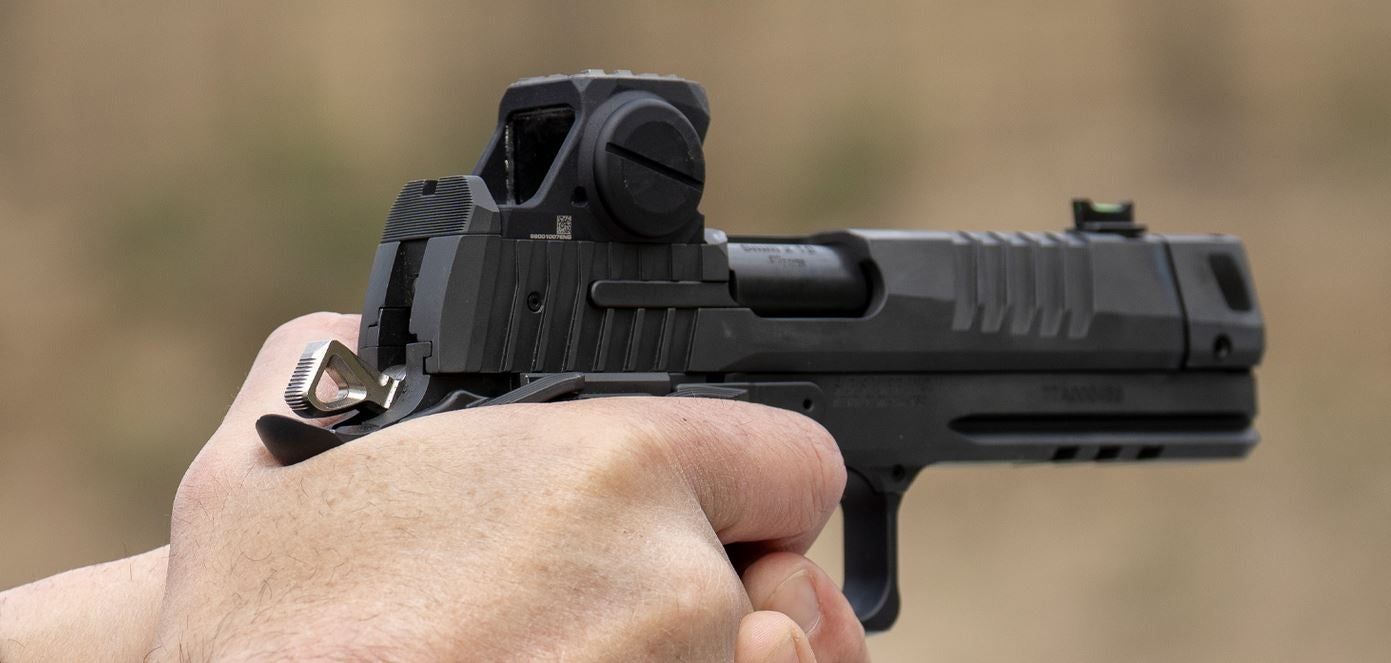
SIG's XRAY5 Swaps Turret Screws for a 225-Dot LED Matrix
SIG Sauer is selling a red dot that never physically moves anything to change your zero. The XRAY5 uses a fixed grid of 225 illuminated points, arranged 15 by 15. To adjust windage or elevation, the electronics light a different point in that grid. SIG prices the Compact at $499.99 and the Pro at $549.99, with SIG-LOC versions listed at $549.99 and $599.99. The Compact fits the Shield RMSc footprint and the Pro fits the DeltaPoint Pro footprint. If you carry a pistol optic every day, the question is simple: does a sight with no moving adjustment parts hold zero better than the sights you already trust?
Key Details
The core specs break down like this:
- Digital Zero: A 225-point matrix in a 15-by-15 grid. The matrix stays still, and the software chooses which point to illuminate when you change zero.
- Dot size: 3.5 MOA.
- Optics: SIG's patented Zero Distortion Optical system. The shooter looks through flat glass, while a collimating lens sits in the housing roof, outside the direct line of sight.
- Housing: 7075 aluminum body, Grade 5 titanium top cover, argon-purged and enclosed, rated IPX8.
- Battery: Side-loading CR2032. SIG claims up to 10,000 hours.
- Durability claims: More than 100,000 consecutive rounds without failure or zero loss, survival of repeated 8-foot drops onto concrete, and submersion testing equivalent to 132 feet. SIG presents these as its own test results.
- Connectivity: Bluetooth and a smartphone app that stores multiple zero profiles.
- Manual controls: Two buttons on the optic handle windage, elevation, brightness, and power without the app.
- Round counter: An accelerometer detects recoil. A five-shot calibration teaches the sight each firearm's recoil signature, and the app logs rounds fired.
- LightFight: Paired with a compatible SIG FOXTROT weapon light, the XRAY5 raises reticle brightness automatically when the light turns on.
Background
Red dots have spent two decades getting smaller, tougher, and cheaper. Enclosed housings replaced exposed designs. Battery life stretched from hours to thousands of hours. Adjustment has barely changed, though. Nearly every mainstream red dot still uses a set of turret screws that physically shift the emitter assembly to move the point of impact on paper. That system works, and it has worked for a long time, but it depends on small moving parts that can shift under recoil or impact.
SIG's own lineup shows the company has built pistol optics around specific footprints. The Shield RMSc and DeltaPoint Pro mounting patterns are the two the XRAY5 targets in its standard configurations. SIG-LOC is the company's newer mounting system for compatible pistols. The XRAY5 carries that heritage forward while replacing the adjustment mechanism underneath it. Digital adjustment is the real departure. Everything else is an evolution of the existing enclosed red dot.
Why It Matters for Gun Owners
Zero retention is the reason most people buy an optic. A carry gun that loses zero after a few hundred rounds or a rough drop is a liability, so SIG's design targets the exact failure mode that frustrates owners. If the durability claims hold up, a pistol with no moving adjustment parts could stay on target through heavy training and daily handling with less babysitting.
Check fit before you get excited. Each variant matches a specific footprint, and SIG-LOC models require a compatible SIG pistol. A Compact on a Shield RMSc plate will not mount on a DeltaPoint Pro pattern without the right hardware. LightFight only works with the SIG FOXTROT light, so buyers running a different weapon light get no automatic brightness adjustment. The round counter depends on calibration, so log your own zero checks alongside it. Finally, the two physical buttons mean you can adjust the sight in the field without a phone, which matters if your battery or app fails at the wrong moment.
DownRange Analysis
Bruen does not touch this product. No court will weigh a red dot's adjustment mechanism against the Second Amendment, so the XRAY5 is a market story, not a legal one. The durability numbers deserve skepticism until independent testers repeat them. A 100,000-round claim without zero loss is an extraordinary figure, and SIG's submersion and drop numbers are manufacturer results. Expect reviewers to test those claims, and wait for their data before you trust your carry gun to this sight.
If you want one now, treat it as a trial. Mount it, zero it, and shoot 500 rounds with a chronograph and a timer. Re-check zero after drops and after a week in the holster. Keep a backup iron sight or a fixed-battery backup optic until the sight proves itself. The XRAY5 is interesting, and the concept is solid, but a gun owner should verify every claim before betting a defensive pistol on it.