Ten Street Works Use Warmth To Reshape Public Space
Ten street artworks across several countries use murals, stencils, chalk, and small interventions to make public space feel warmer. The source material is a photo roundup, not firearms news, so this piece treats it as a cultural story about how art changes the feel of a wall, a building, or a street corner.
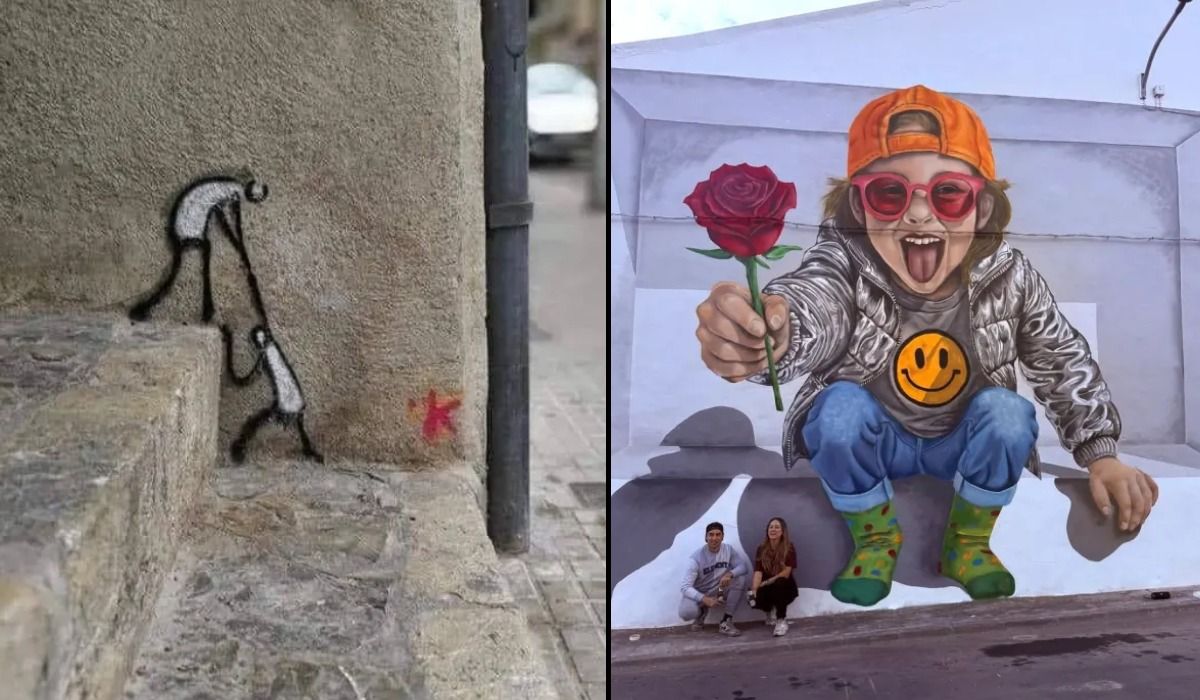
The works share a common move. A rose is offered across a wall. A dog reaches toward a painted child. Tiny figures climb, share, and wait for one another. Each piece asks the passerby to slow down and notice something small.
Key Details
David Zinn's official print page identifies The Elopement as a chalk-and-charcoal piece made with an ivy strand in Ann Arbor, Michigan, dated January 1, 2024. One mouse climbs the ivy while another waits in a window. Zinn's official biography says his temporary street drawings are made entirely from chalk, charcoal, and found objects, improvised on location.
In Ajaccio, Corsica, a work titled In Your Hands pairs painted hands and soil with a living tree. Martinetti's post presents it as a collaboration with students from the Collège-Lycée Saint-Paul in Ajaccio. The painted element sets up the idea, and the real tree finishes it.
The City of Antibes artwork directory confirms the mural Churu, a 2025 work by Chilean muralist Javier Barriga. It was made for Coul'Heures d'Automne and painted on the psychiatry building of Hôpital de la Fontonne at 107 Avenue de Nice. In Glasgow, the City Centre Mural Trail lists St Enoch and Child by SMUG at 6 George Street.
On a silo in Melbourne's Brunswick neighborhood, Loretta Lizzio painted a mural based on the widely shared image of then-New Zealand Prime Minister Jacinda Ardern embracing a Muslim woman after the Christchurch mosque attacks. Brunswick Voice notes the 18-metre work was completed in 2019.
Background
Street art has long moved between decoration and dialogue. Murals once served mostly as civic beautification or political statement. Over the past two decades, many artists have shifted toward intimate scenes that invite a pause rather than a shout.
Temporary work like Zinn's chalk drawings reflects a related tradition. Such pieces exist only until rain, foot traffic, or weather erases them, which makes each encounter feel like a chance discovery. Permanent murals, by contrast, anchor a neighborhood's identity and often become landmarks.
Several works in the roundup tie into local history or civic symbols. Glasgow's SMUG mural draws on St Mungo legends and the city's crest, which features a robin. The Antibes mural sits on a hospital building, linking art to a care setting. These connections show how artists borrow meaning from the places they paint.
Why It Matters for Gun Owners
This is not a firearms story, and DownRange readers should not expect gear reviews or legal analysis here. Still, there is a practical overlap. Many gun owners spend time in public spaces, and the look and feel of a city affects how people move, gather, and interact.
Art that softens a public square can reduce the sense of hard edges that sometimes accompanies urban life. Whether or not one agrees with any particular mural, the broader lesson is that shared spaces shape behavior. Owners who carry responsibly already understand that environment and awareness matter as much as equipment.
The roundup also shows how communities choose what to display in public. Murals get commissioned, debated, and sometimes removed. Gun owners who care about civic participation have a stake in those same decisions about how their towns are presented.
DownRange Bottom Line
These ten works are a reminder that public space carries meaning beyond utility. A rose on a wall, a dog beside a child, or a mouse climbing ivy each asks for a moment of attention. That is a modest ask, and it works.
For DownRange readers, the takeaway is simple. Notice the spaces you pass through every day. The best of them were designed by someone who wanted you to feel something on the way by.