
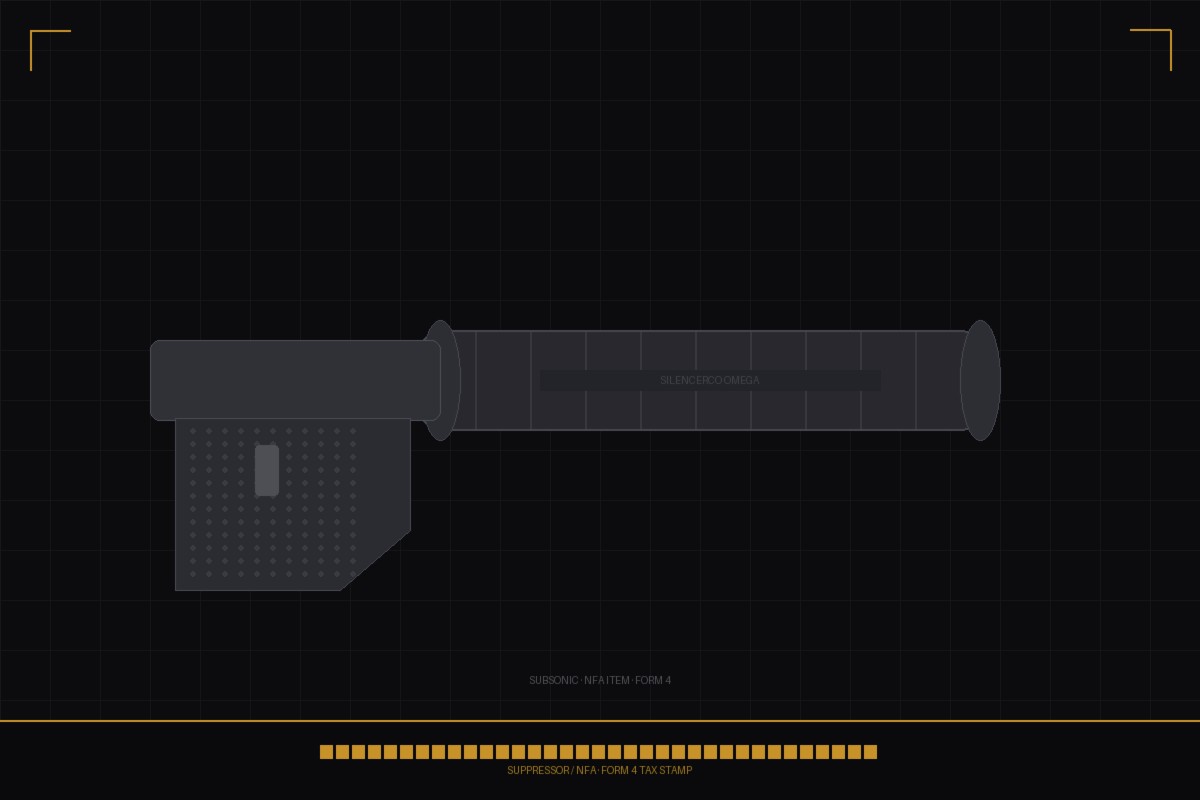
The National Firearms Act of 1934 created a regulated category of firearms and accessories that required registration with the federal government and payment of a $200 tax stamp. For 90 years, the process took 6–12 months and cost $200 plus the item price.
In January 2026, Congress eliminated the $200 NFA tax stamp requirement and streamlined the approval process to 30–60 days. The result: suppressor sales doubled in the first quarter. If you've been curious about suppressors, SBRs, or other NFA items, now is the time to understand how it works.
What Items Are NFA-Regulated
The NFA regulates six categories of items:
The 2026 Suppressor Revolution
The elimination of the $200 tax stamp effective January 1, 2026 changed the math on suppressor ownership dramatically.
Before 2026: a budget suppressor (Dead Air Ghost, $400) + $200 tax stamp + 8-month wait = $600 and most of a year. The wait was the real barrier — most suppressor buyers filed their paperwork and then largely forgot about it until the stamp arrived.
After 2026: same suppressor, no stamp fee, 30–60 day approval. The process is now comparable to buying a standard firearm — background check, approval, take it home.
SBRs: The Practical Case
A short-barreled rifle (SBR) is typically an AR-15 or pistol-caliber carbine with a barrel under 16". The practical advantages for home defense and general use:
Maneuverability — a 10.5" barrel AR-15 is dramatically easier to handle in home hallways, vehicles, and tight spaces than a standard 16" rifle. The tradeoff is modest velocity loss (roughly 200 fps compared to 16" barrel) which doesn't significantly affect terminal performance at defensive distances.
Suppressor host — a short-barreled rifle with a suppressor can be overall shorter than a standard rifle without a suppressor, while adding the hearing protection benefits.
The SBR process post-2026 is identical to suppressors: eForm 1 or Form 4, background check, ATF approval (30–60 days), and you're legal.
Important caveat: SBRs remain illegal in some states regardless of federal law — California, New York, New Jersey, Connecticut, Maryland, Massachusetts, Hawaii, Rhode Island, Illinois, and others restrict SBRs under state law. Check your state before filing.
Alternatively: AR pistols (pistol-braced ARs with barrels under 16") occupy a legal gray area that has been clarified post-2026. With the pistol brace rule rescinded, AR pistols with braces are now clearly legal without NFA registration in states that allow them.
How to Buy Your First Suppressor (Step by Step)
Step 1 — Choose your suppressor and purchase it from an FFL/SOT dealer (dealers licensed for NFA items). You pay for the suppressor, and it transfers to the dealer's inventory under your name.
Step 2 — Complete ATF eForm 4 online at eforms.atf.gov. You'll need: your information, the suppressor serial number, photos, and digital fingerprints (most dealers have a fingerprint capture device).
Step 3 — The dealer submits your Form 4 to ATF. You wait. Currently 30–60 days for eForm 4. ATF runs an extended background check and reviews the form.
Step 4 — ATF approves and the tax stamp (now $0) is issued to your dealer. The dealer contacts you. You pick up your suppressor.
Step 5 — Your suppressor is now registered to you. It must stay within your possession or the possession of someone with your explicit (written) authorization. You cannot permanently transfer it to anyone else without another Form 4 and ATF approval.
For couples or families who want multiple authorized users: file using a gun trust (also called an NFA trust). A trust allows any trustee to possess and use the item. Most attorneys charge $150–$300 for a basic NFA trust; several online services (Silencer Shop, QuietBore) provide trust forms for free.

DJ Cavalcanti founded DownRange on a simple idea: the Second Amendment community deserves better information. He built the platform to make firearms news, state gun laws, legal developments, and market intelligence freely available to every gun owner — in one place, updated constantly.