Two D.C. Gun Owners Ask Full Circuit to Reopen Magazine Ban Case
Firearms Policy Coalition and two Washington, D.C., gun owners, William Wehr-Darroca and Gary Stemple, asked the full U.S. Court of Appeals for the D.C. Circuit to reconsider the standing rules that kept their challenge to the District's magazine ban out of court. They filed an opening appeal brief and a petition for initial hearing en banc on October 15. The plaintiffs want the court to reverse a standing dismissal and send the case back for further proceedings. They are not asking the judges to rule on whether the magazine restriction violates the Second Amendment. They want the courthouse door open first, and they know the current circuit precedent is standing in the way.
Key Details
The case is docketed as No. 25-7159. The district court dismissed it on September 22, 2025, holding that binding D.C. Circuit precedent requires more than an allegation that the plaintiffs would engage in prohibited conduct but for the law. The plaintiffs conceded they could not satisfy that precedent while still arguing it should be overturned.
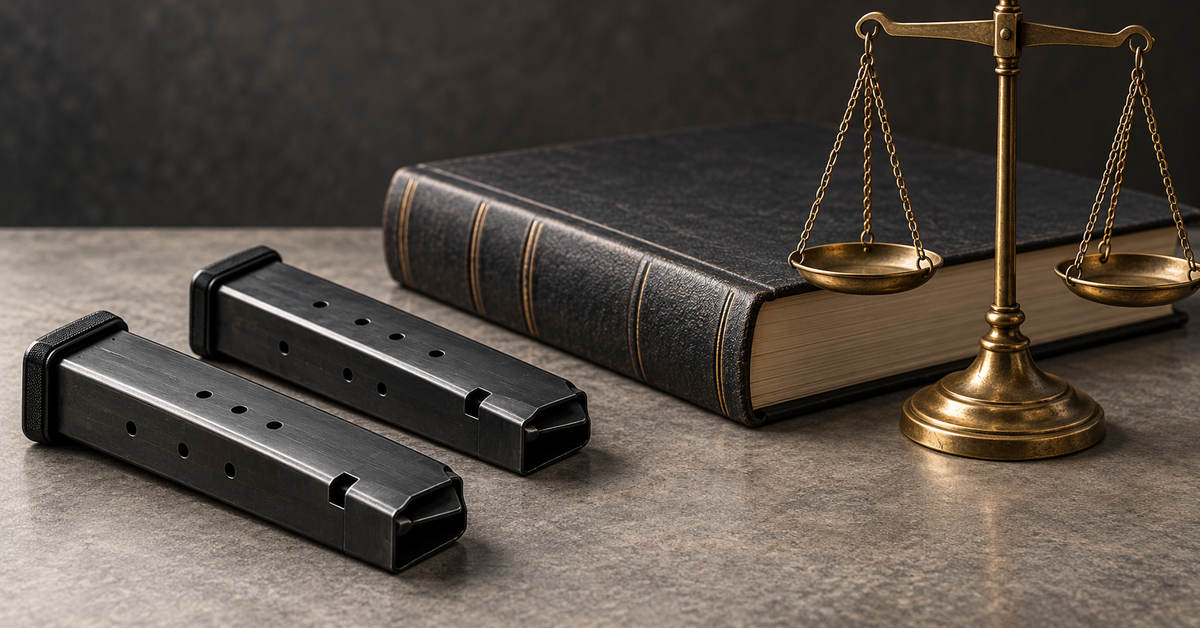
The law at issue is D.C. Code Section 7-2506.01(b)-(c). It bans knowingly possessing, selling or transferring ammunition-feeding devices that hold more than 10 rounds, or that can be readily restored or converted to hold more than 10. The prohibition applies whether or not the magazine is attached to a firearm. The definition carves out an attached tubular device designed for, and operating only with, .22-caliber rimfire ammunition.
- Plaintiffs' handguns shipped with magazines the District prohibits.
- They stored those magazines outside D.C. and bought compliant replacements.
- The brief argues that avoiding conduct a criminal statute bars should not require a special threat of prosecution before a challenge can proceed.
- The alternative theory: money spent complying with the restriction counts as a sufficient injury for standing.
- That alternative argument leans on the circuit's recent Angelo decision.
- The lower court applied the circuit's Navegar, Seegars and Parker precedents.
The filing does not create a new holding. It asks the full court to change its approach or accept compliance costs as an injury. Filing an appeal or requesting en banc review does not suspend the statutory prohibition, so the ban remains enforceable while the case moves.
Background
Standing sits at the front of every federal lawsuit. A plaintiff must show a concrete, particularized injury that traces to the challenged law and that a court can redress. The Supreme Court laid out that framework in Lujan v. Defenders of Wildlife in 1992. Pre-enforcement challenges, where a plaintiff sues before any prosecution, add another layer. In Susan B. Anthony List v. Driehaus in 2014, the Court held that a plaintiff can sue over a law they intend to violate only if the intended conduct is arguably protected and the threat of enforcement is substantial.
Gun owners have run into that wall repeatedly. A plaintiff who wants to keep lawfully owned property in a restricted jurisdiction faces a choice: break the law to create standing or comply and stay out of court. The plaintiffs here chose compliance, then sued. Their lawyers at FPC argue that choice should not disqualify them. The circuit's precedent says otherwise for now.
On the merits, New York State Rifle & Pistol Association v. Bruen in 2022 set the test. Government must justify a firearm restriction by showing it fits the nation's historical tradition of firearm regulation. That test has pushed magazine and capacity limits into a new round of litigation nationwide. The D.C. case has not reached that question yet.
Why It Matters for Gun Owners
Anyone who travels with a pistol or carries a magazine across a jurisdictional line should read this case closely. D.C.'s prohibition covers the device itself, not just the gun it fits into. A magazine bought legally in Virginia or Maryland becomes a criminal problem the moment it crosses into the District, even if it never sees a firearm. That reality matters for commuters, out-of-state buyers who ship firearms, and anyone who keeps spare magazines in a vehicle.
The standing question also reaches beyond D.C. Other states with capacity limits face the same threshold problem. If the full circuit enforces a strict pre-enforcement standard, challengers in jurisdictions with hostile circuit precedent will struggle to get any merits ruling. If the court accepts compliance costs as injury, the door opens for a much wider class of plaintiffs who have already spent money to satisfy a ban.
Watch the docket for the response from the District and whether the court grants initial hearing en banc. Watch also whether the court addresses the Angelo-based compliance-cost theory directly.
DownRange Analysis
This filing is smart lawyering with a clear limit. FPC is not asking for a quick win on the merits. It is asking the court to fix the threshold problem that has kept Second Amendment cases from being heard. Under Bruen, a court cannot answer the historical question if it never reaches it. The plaintiffs are right that a rule requiring someone to break a criminal law just to earn standing is hard to square with the Second Amendment's core protection.
Compliance costs are a more interesting argument. Replacing magazines costs real money, and courts have recognized economic injury in other contexts. If the full circuit accepts that theory, the District would have a harder time keeping challenges out on procedural grounds. Expect the District to argue that the cost is self-inflicted and that the plaintiffs chose to comply.
What should a D.C.-area owner do now? Check the magazine capacity of every device before it crosses the District line. Keep detached magazines stored lawfully and out of reach while traveling. Do not assume a pending lawsuit changes what is legal today. The ban is enforceable until a court says otherwise.