Tomb Sentinels Have Carried the M14 for 69 Years
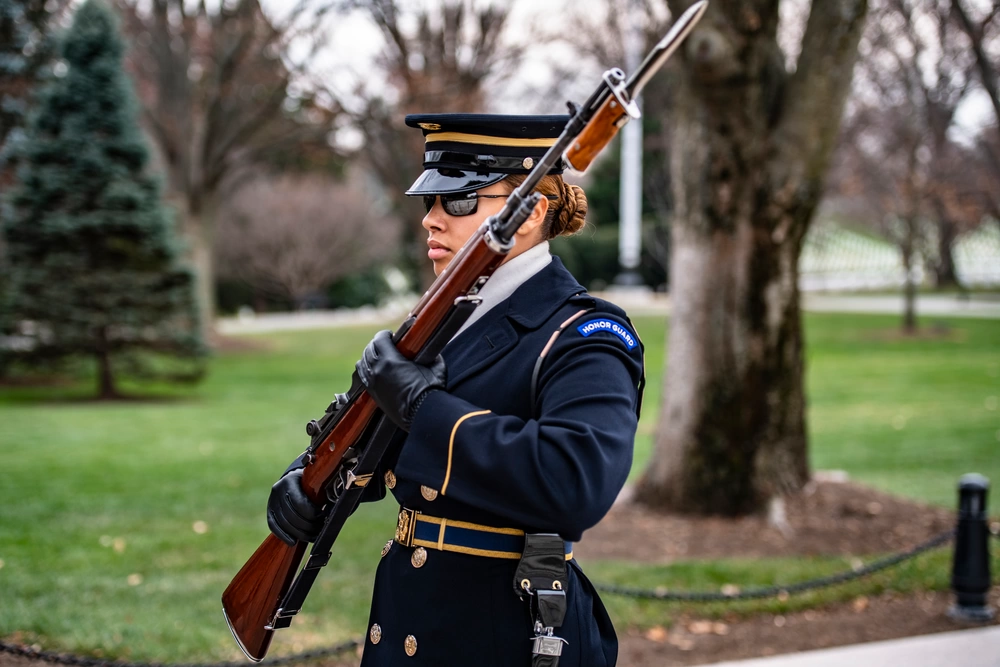
The Sentinels guarding the Tomb of the Unknown Soldier at Arlington National Cemetery have carried the M14 rifle since 1957. That is 69 years with one rifle on one post. TTAG's Tomb series traces every rifle the guard has carried since the memorial opened on March 24, 1926, and asks why the unit never adopted the M4 carbine that the Army issues today. The short answer is tradition. The guard carries a wood-stocked battle rifle built for ceremony, and it has done so for most of a century. Three rifles have held that post: the M1903 Springfield, the M1 Garand, and the M14.
Key Details
The series lays out a clear timeline. Each rifle served the guard during a specific stretch of the Army's history.
- M1903 Springfield: Adopted in June 1903 to replace the .30-40 Krag. It was based on Mauser patents, and the U.S. paid royalties to Mauser until 1918. It fed from an internal 5-round box magazine loaded by stripper clip. The Sentinels carried it with the M1905 bayonet from the Tomb's opening until 1936.
- M1 Garand: Chambered in .30-06, it was the first semi-automatic battle rifle the U.S. military fielded. John Garand designed it at the Springfield Armory. The Army adopted it on January 9, 1936, and more than 5.4 million were produced. The Sentinels carried it with the M1942 bayonet from 1936 to 1957.
- M14: Designed as an "improved" M1 Garand, it used a 20-round box magazine and offered select-fire capability. The Army adopted it in 1957 to replace the Garand, the M3 submachine gun, and the BAR. It chambers the 7.62x51mm (.308) cartridge. The Sentinels started carrying it in 1957 with the M6 bayonet.
- Weight: The Sentinels' M14 weighs about 9 pounds. Its wood stock suits ceremonial work.
The author reports no current movement to replace the M14 with another rifle. He describes the guard's handling of the rifle as effortless, and he urges visitors to watch the changing of the guard in person.
Background
The Army adopted the M14 in 1957 as its main battle rifle. The rifle served until the M16 replaced it in Army service between 1964 and 1967. The Army cited the M14's weight and a shift in thinking about what infantry needed in changing combat conditions. The M14 never disappeared, though. Designated marksmen kept using the .308 round for years, and the platform survived in updated forms with synthetic stocks and other modifications.
The Garand's history explains the M14's design. Infantry users complained that the Garand's en bloc clip design limited reloads. The M14 answered that complaint with a detachable box magazine. The Tomb guard's rifles followed the Army's own sequence. Each change in standard issue eventually reached the ceremonial detail, though the Sentinels kept older designs in service long after the line units moved on.
Why It Matters for Gun Owners
The Tomb's rifle history matters because it maps directly onto the civilian market. The M14 lineage produced the M1A, a semi-automatic civilian rifle built on the same action and sold in the United States. A buyer who wants the Tomb guard's rifle in semi-auto form can buy one legally in most states. The select-fire M14 falls under the National Firearms Act, and the registration and tax rules that come with it still apply. Know that difference before you buy anything labeled M14 or M1A.
Surplus collectors should also pay attention. The M1 Garand and 1903 Springfield remain popular surplus rifles, and the market rewards clean examples with original parts. Check headspace and bore condition before you shoot a used military rifle, and verify the importer paperwork for any imported piece. Watch for vendors who blur the line between semi-auto and select-fire by using military nomenclature in listings. Read the paperwork, not the marketing.
DownRange Analysis
The Tomb guard's rifles tell a useful story about how the government treats military arms. The Supreme Court in United States v. Miller (1939) and District of Columbia v. Heller (2008) tied protected arms to those in common military use. The Garand, the M14, and the M16 all fit that test without debate. Under New York State Rifle & Pistol Association v. Bruen (2022), a state must show that a restriction matches the historical tradition of firearm regulation. A modern rifle the Army has fielded for decades is hard to ban under that framework, and the Tomb's rifle history makes the point for us.
The market lesson is simpler. The M14 has outlasted its service run by decades, and it still sells. Buy the rifle you can legally own, store it right, and learn the platform. If you live in Virginia or the District of Columbia, check local rules before you buy, and confirm that any accessory or magazine you add stays within state law. Then go watch the changing of the guard. You will not forget it.