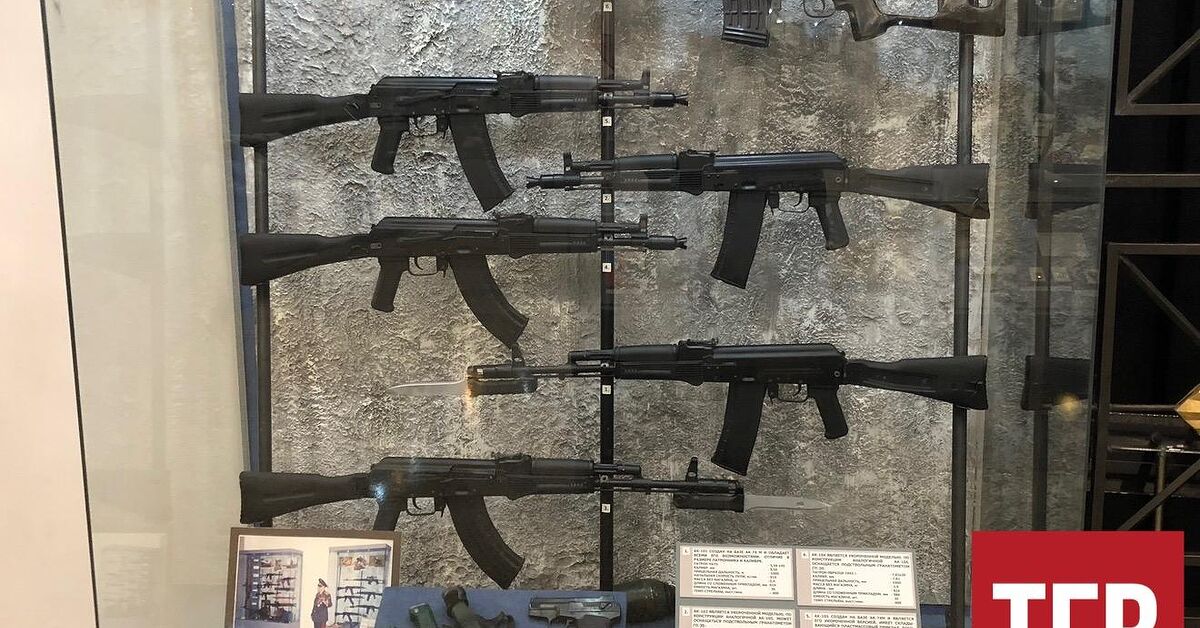
Inside the AK-100 Series
Russia's Izhmash developed the AK-100 series during the 1990s economic collapse to save the company from bankruptcy. The modular rifle family shares 70% of components across seven different models chambered in 5.45x39mm, 7.62x39mm, and 5.56x45mm NATO. Izhmash engineers created the AK-101, AK-102, AK-103, AK-104, AK-105, AK-107, and AK-108 between 1994 and 2002. Each rifle uses the same receiver, bolt carrier, trigger group, and furniture while changing barrels, magazines, and gas systems for different calibers. The AK-101 and AK-102 fire 5.56x45mm NATO rounds. The AK-103 and AK-104 chamber 7.62x39mm Soviet. The AK-105 uses 5.45x39mm rounds. The AK-107 and AK-108 feature balanced recoil systems with counter-mass mechanisms. Production costs dropped 40% compared to manufacturing separate rifle designs.
Background and Context
The Soviet Union's 1991 collapse devastated Russia's defense industry. Izhmash lost 90% of its government contracts and faced closure by 1993. Export sales became the only path to survival. Foreign militaries wanted rifles chambered in NATO 5.56x45mm ammunition, not Soviet 5.45x39mm rounds. Traditional AK-74 rifles required complete redesigns for different calibers. Chief designer Vladimir Zlobin proposed a modular system in 1992. His team reverse-engineered captured M16A2 rifles to understand 5.56x45mm ballistics. They tested 200 different gas port sizes and buffer weights. The first AK-101 prototypes fired in December 1993. Russian Spetsnaz units tested early models in Chechnya during 1995. The rifles passed 50,000-round endurance tests without major failures. Venezuela ordered 100,000 AK-103 rifles in 2005 for $54 million. The contract saved Izhmash from a second bankruptcy.
What This Means for Gun Owners
American civilians cannot legally import true AK-100 series rifles due to the 1994 assault weapons import ban and 2014 Russian sanctions. Century Arms imports Romanian and Bulgarian copies as the C39v2 and WASR series. These rifles cost $800 to $1,200 compared to $2,500 for pre-ban Russian imports. Parts compatibility remains high between AK-100 variants and standard AKM rifles. Magazines, stocks, and handguards interchange freely. The balanced recoil system from AK-107 rifles appears in some American-made variants. Rifle Dynamics offers AK-107 style builds for $3,500. Arsenal Inc. imports Bulgarian AK-104 copies as the SLR-104FR for $1,800. Palmetto State Armory produces 5.56x45mm AK rifles based on AK-101 designs for $650. These rifles offer NATO ammunition compatibility with proven AK reliability.
Industry Impact
The AK-100 series changed how manufacturers design rifle families. Sig Sauer adopted similar modular concepts for the MCX and MPX platforms. Daniel Defense uses shared components across DDM4 variants. The modular approach reduces manufacturing costs by 30% to 50% industry-wide. Russian arms exports increased from $1.2 billion in 1995 to $15.7 billion in 2019, partly due to AK-100 sales. India licensed AK-103 production and manufactures 750,000 rifles annually. Egypt produces AK-103 rifles under Russian license since 2018. Nigeria ordered 1,000 AK-103 rifles in 2021 despite U.S. objections. The rifles compete directly with American M4A1 carbines in international markets. Unit costs remain 40% lower than comparable Western rifles.
What to Watch Next
Russia launched the AK-12 and AK-15 in 2018 to replace AK-100 series production. These newer rifles use different magazines and parts, ending the modular concept. Existing AK-100 rifles will remain in service until 2035. American manufacturers continue developing AK-based rifles for civilian markets. Palmetto State Armory plans 7.62x51mm NATO AK rifles for 2024. Kalashnikov USA produces AK-103 copies as the KR-103 for $1,000. Import restrictions prevent direct Russian competition in American markets. Bulgarian and Romanian factories increase production to fill demand. The modular design principles influence next-generation rifle development worldwide. Military customers want caliber flexibility without complete weapon system changes.
DownRange Bottom Line: The AK-100 series proved modular rifle design works when done correctly. American gun owners benefit from the parts standardization and lower manufacturing costs these rifles introduced.