Your Ultrasonic Cleaner Can Ruin Aluminum Baffles. Stick to This List.
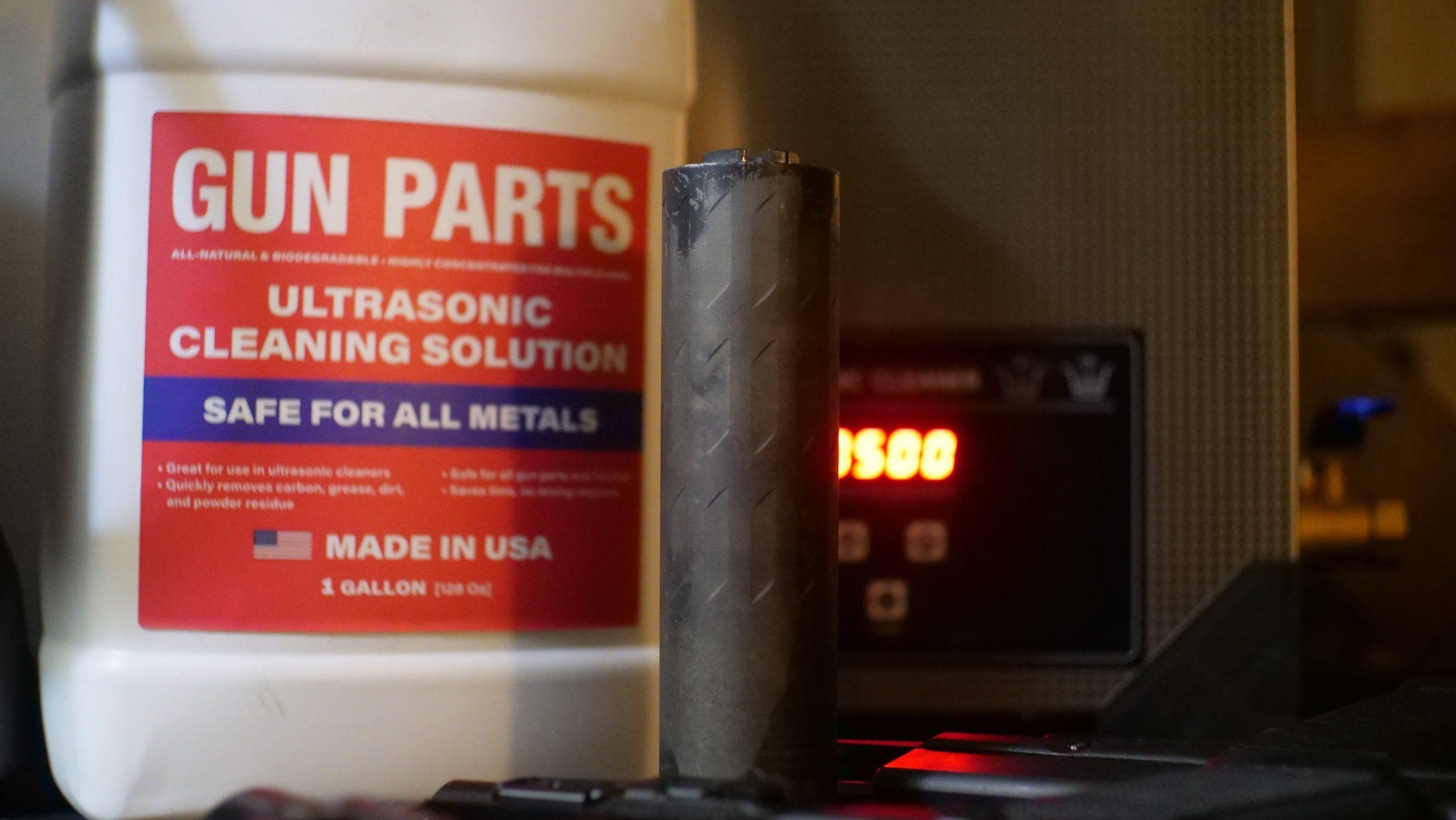
Put an aluminum baffle in an ultrasonic cleaner and you can damage it. Silencer Shop's materials chart approves ultrasonic cleaning for stainless steel and titanium and rules it out for aluminum. Silencer Shop recommends cleaning rimfire suppressors every 300 to 500 rounds, because rimfire cans collect lead and carbon fast. TTAG's published guide walks through which parts go in the tank, which solvents are safe, and which liquids will start a fire. The short version: bare stainless and titanium go in, aluminum stays out, and flammable solvents never touch the bath.
Key Details
The cleaning process depends on a transducer mounted under the tank. It vibrates the fluid tens of thousands of times per second. Each pressure cycle creates microscopic bubbles that collapse against surfaces and knock carbon and lead loose, including spots a pick or brush cannot reach.
- Approved materials: Bare stainless steel and titanium baffles, monocores, and end caps. Inconel parts qualify only if the solvent is rated for Inconel.
- Aluminum: Not approved for ultrasonic cleaning. Many common firearm coatings also fail under cavitation.
- Simple Green All-Purpose Cleaner: A concentrate at about pH 9.5. Its directions limit contact with unprotected aluminum to 10 minutes. Extended use runs no hotter than roughly 105 to 108 degrees Fahrenheit, and the manufacturer tolerates 140 degrees only briefly.
- Simple Green Pro HD and Extreme Simple Green Aircraft & Precision Cleaner: Formulated for aircraft aluminum. Simple Green recommends the Extreme formula for bench ultrasonic units. Neither makes aluminum baffles safe in the tank.
- Dish soap and warm water: The mildest option. Fletcher Rifle Works recommends it for its Taquito 22LR suppressor. Do not run it through the ultrasonic cycle on aluminum.
- White vinegar: A low-cost pretreatment soak for rimfire lead. It converts lead into lead acetate, which is toxic. Use it on stainless only and treat the spent liquid as lead waste.
- C.A.T 206: A synthetic acid cleaner for titanium and Inconel. The product page calls for a three-hour submersion for routine cleaning and up to 12 hours for cans with more than 2,000 rounds since the last cleaning. Skip pre-cleaning with CLP, which interferes with its reaction on carbon.
- HUXWRX Suppressor Sauce: A two-part, single-use powder. Part A removes carbon, and Part B removes lead and copper. It works as a soak, and Silencer Shop rates it safe on common suppressor materials, including sealed and aluminum cans that cannot go in an ultrasonic tank.
Silencer Shop also warns against brake cleaner, WD-40, and ammonia-based or chlorinated cleaners on titanium. Check the owner's manual before you start, because some manufacturers void warranties for ultrasonic cleaning or for specific solvents.
Background
Suppressors moved from niche accessories to mainstream gear over the past decade. Most owners now buy a can, shoot it, and then face the cleaning question. Rimfire cans are the worst offenders. Their designs trap lead and carbon in tight baffle stacks, and hand scrubbing a full stack takes real time. That is why many owners now buy ultrasonic cleaners, and the author of TTAG's guide admits he bought one for exactly that reason.
Centerfire rifle suppressors need far less maintenance. Gas flow pushes most carbon out the front, so the ultrasonic tank mostly earns its keep on rimfire cans. Industry solvents have multiplied alongside the growth in suppressor ownership, and several are now marketed specifically for suppressor parts. The federal $200 NFA tax stamp once made suppressor ownership a months-long process, and the 2025 federal tax law reduced the tax on suppressors to $0 starting January 1, 2026. More owners now own cans, and more of them are learning the hard way which cleaners damage metal.
Why It Matters for Gun Owners
Any owner running a rimfire can through an ultrasonic bath needs a parts inventory before the first cycle. Check every baffle. Stainless and titanium go in. Aluminum stays out, even if the manual is vague or the box says "suppressor safe." Aluminum cans and sealed cans need a soak-based approach, and the bath cannot fix that.
Solvent choice matters as much as metal choice. A generic degreaser can look harmless and still attack a titanium part or coating. Heat matters too. A tank heater left on high can push a mild concentrate past its design limit, and a heated bath accelerates reactions that a cold soak would leave alone. Owners running Simple Green should set the heater low and rinse parts in fresh water afterward.
Fire risk belongs in every shop. Gasoline, mineral spirits, and alcohol produce vapor, and agitation and heat push that vapor into the air. Ultrasonic cleaner makers prohibit flammable solvents for that reason. A garage with a space heater, a water heater, or a welding station has no room for that mistake.
DownRange Analysis
Cleaning a suppressor is maintenance, not a constitutional question, but the same discipline applies. Know your materials, respect the manufacturer's limits, and keep track of what you put in the tank. A can that fails because of aluminum exposure is a can you cannot replace cheaply, and no court will hand you a new one.
The market is moving toward specialized formulas. C.A.T 206 and HUXWRX Suppressor Sauce cost more per ounce, but they promise less scrubbing and cover parts a bath cannot handle. Test a single product on a spare baffle before you commit a full can. Vendors vary in how carefully they test their claims, and the manufacturer's written guidance overrides any marketing copy.
Right now, do three things. Pull the owner's manual for every can you own. Sort your parts into stainless, titanium, Inconel, and aluminum. Then run only the approved materials through a bench unit at a low heater setting, using a solvent rated for those specific metals. Everything else gets a soak, a brush, or a trip to the bench.