
Canadian Cabinet Member Pushed Handgun Range Ban, Court Docs Reveal
ATIP Documents Expose Policy Pressure Behind C-21 Restrictions
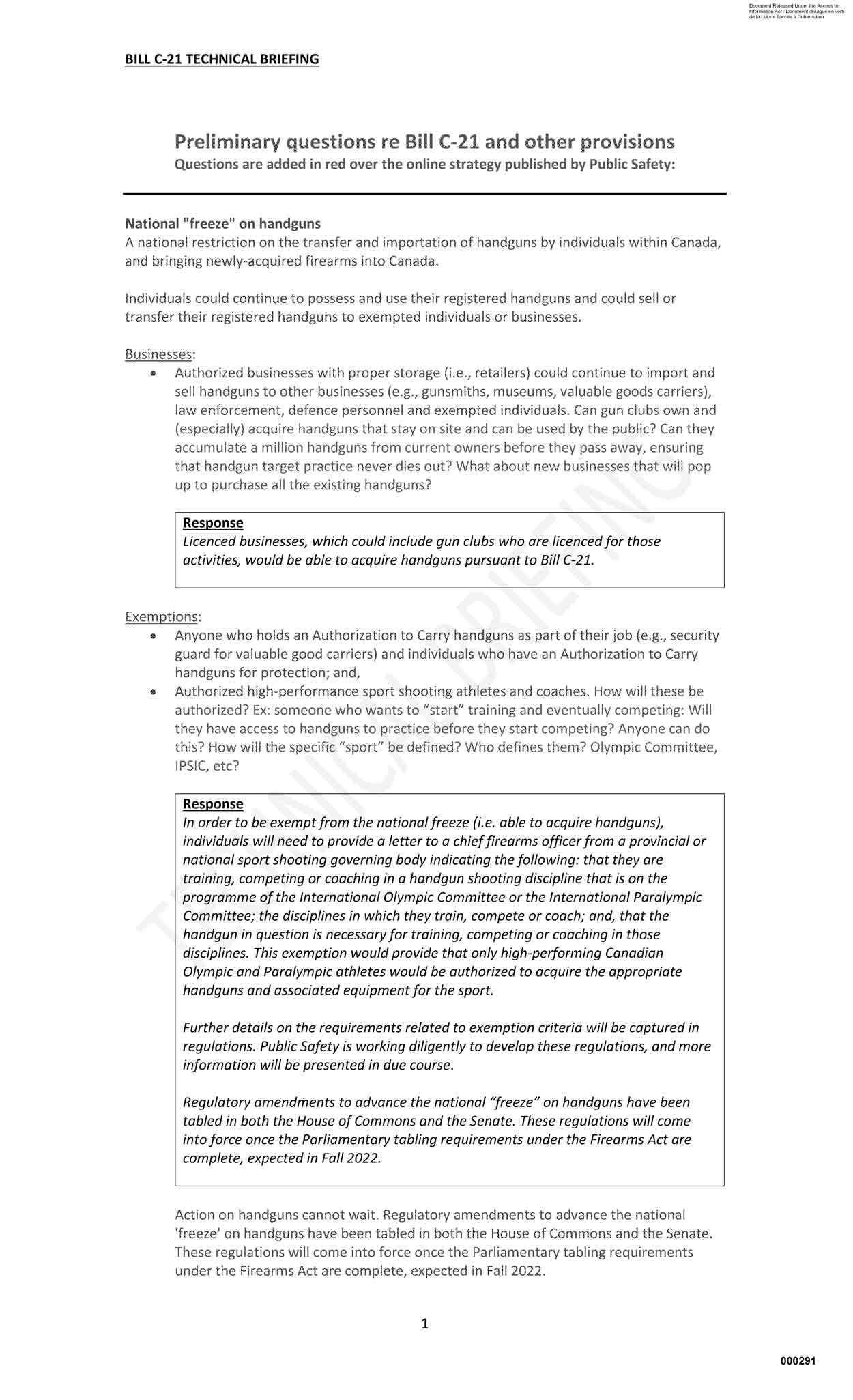
Newly released Access to Information (ATIP) documents have revealed that a Canadian Cabinet member actively pushed for a handgun shooting range ban during the development of Bill C-21. The disclosure provides direct evidence of political pressure driving some of the legislation's most contentious proposals—and offers tactical insight into how policy advocacy shaped the government's firearms agenda.
The documents, obtained by Calibre Press, show that stakeholder groups and government officials pursued measures far beyond what eventually made it into the final bill. Among the most aggressive proposals was a nationwide handgun range prohibition, a move that would have effectively eliminated sanctioned civilian handgun training and competition shooting across Canada. While this specific measure did not survive to become law, the revelation underscores the legislative direction firearms policy was heading before industry and legal pushback.
What the Documents Actually Show
The ATIP release captures internal government correspondence and stakeholder submissions during C-21's development phase. Cabinet-level advocacy for the range ban represents a significant data point: it demonstrates that restrictions presented as evidence-based policy responses were, in fact, driven by political preference and pressure from advocacy coalitions rather than empirical crime data or public safety metrics.
Handgun ranges in Canada are already subject to strict licensing, facility standards, and provincial oversight. Licensed shooting ranges operate under Transport Canada and provincial regulations. Range shooters undergo background checks identical to other firearms owners. The institutional reality made the proposed ban particularly significant—it wasn't a response to documented range-based criminal activity but rather a ideological push to further restrict civilian handgun access.
The Broader C-21 Context
Bill C-21, introduced in 2022 and substantially amended through 2024, has reshaped Canadian firearms law. The legislation included:
- A mandatory handgun freeze (later delayed by legal challenge)
- Criminalisation of most semi-automatic rifles
- Prohibition on handgun ammunition sales to civilians
- Expansion of police discretion in issuing firearms licences
- Attempted restrictions on online firearms sales and ammunition distribution
The Cabinet-member-pushed range ban, while ultimately not enacted, sat within this broader maximalist policy framework. It reveals the legislative ceiling—what officials were willing to propose—versus what eventually cleared parliamentary passage.
Practical Impact on Canadian Range Operations
Though the handgun range ban did not become law, Canadian shooting ranges have already experienced significant operational constraints. The ammunition prohibition creates practical barriers: shooters cannot legally purchase ammunition for handgun training, making range attendance increasingly difficult even where facilities remain open. Several ranges have reduced hours or ceased handgun-specific programming due to ammunition scarcity and liability concerns.
Range operators have reported that the cumulative effect of C-21 measures—even those that survived to enactment—mirrors the severity of the initially proposed handgun range closure. Without ammunition availability and facing regulatory uncertainty, many ranges have de facto shifted away from handgun-focused operations.
What Gun Owners Should Know
For Canadian firearm owners, the ATIP release carries several actionable implications:
- Policy advocacy at the Cabinet level operates beyond public consultation. Private stakeholder pressure shapes legislative direction significantly.
- Defeated proposals establish the negotiation baseline for future legislation. A range ban proposed in 2022 could reappear in future bills with different framing.
- Cumulative restrictions—ammunition bans combined with regulatory uncertainty—can achieve the functional effect of a direct ban without explicit statutory language.
- ATIP requests remain an effective tool for exposing policy development rationale and identifying undisclosed stakeholder influence.
Next Steps for the Firearms Community
These documents provide evidentiary foundation for legal challenges and parliamentary testimony. They demonstrate that policy was driven by ideology rather than data, which may support arguments in ongoing constitutional litigation over C-21's ammunition prohibitions and other measures.
Canadian gun owners should continue filing ATIP requests on firearms policy development, regulations, and enforcement directives. The paper trail—accessible through systematic information requests—remains the most reliable source of policy intelligence and accountability documentation available to the shooting community.

